
CEM & Diffraction
Head
Christophe GUIFFAUT
 christophe.guiffaut@xlim.fr
Secretariat
Marie CELERIER
Nadine AYMARD
marie.celerier@xlim.fr nadine.aymard@xlim.fr
Staff
8 permanent staff, 5 PhD students, 2 postdocs, 4 master’s interns
EMC of Components
In the very near field, direct electromagnetic couplings are established between conductors (coupled cables, printed conductors, conductor-to-structure), generating parasitic signals. The increase in the number of electronic systems, onboard or not, and of potential disturbance sources makes coexistence problems crucial.
EMC of High-Power Microwaves
…
CEM Foudre
Natural phenomena such as lightning are also the source of broadband, low-frequency electromagnetic radiation and of significant induced currents in terrestrial power networks, buildings and aircraft.
Application areas: Aeronautics, buried structures, buildings, transport…
Themes :
 Modelling of indirect effects on aircraft: evaluation of current stresses on cables and in assemblies using the 3D FDTD method. Support for aircraft EMC certification through numerical simulation.
Modelling of complex in-situ cable topologies.
Building cable models in lossy media (concrete, soil, etc.).
Studies on electromagnetic models of conductors, slots, circuits, fasteners, etc., and their implementation within the FDTD method.
Massively parallel computing (TEMSI-FD solver)
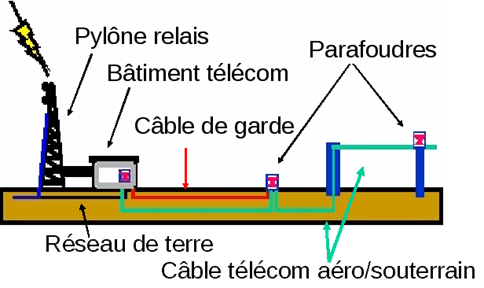
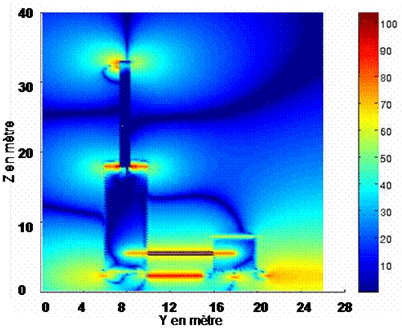
Currents induced on overhead / underground lines during a lightning strike on a telecom building (partnership with Orange Labs).
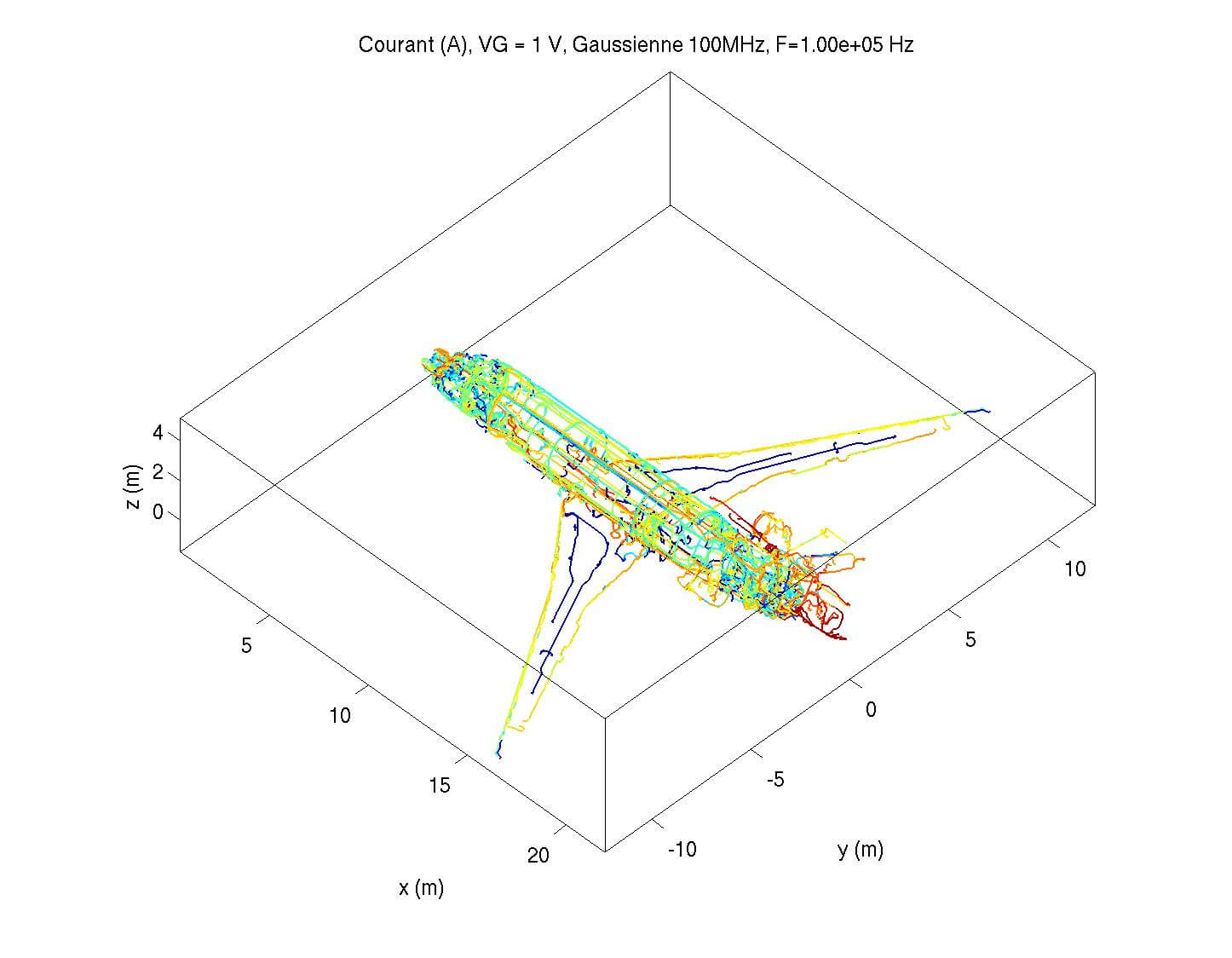
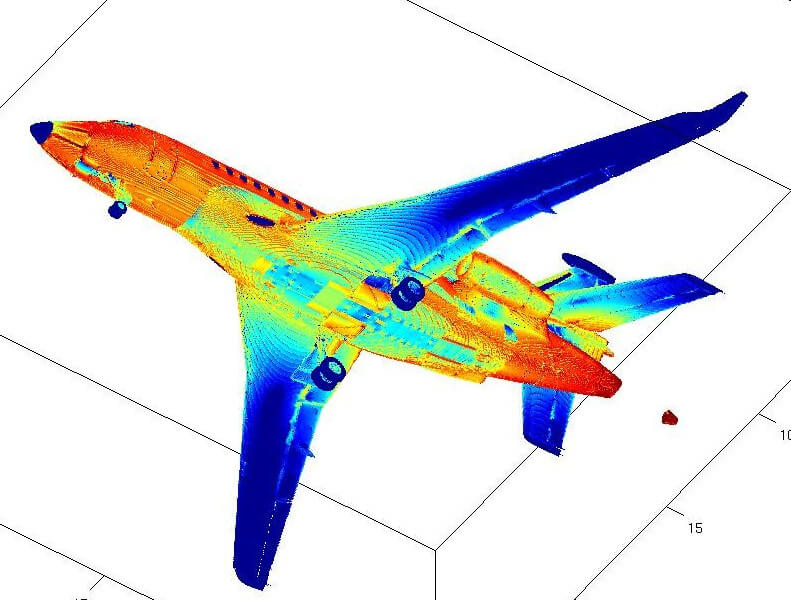
Current density on aircraft skin (partnership with Dassault Aviation)
Development and optimisation of EMC test facilities
…
Sensitivity analysis and probability of failure
…

Electric field distribution from several Wi-Fi sources inside a Falcon-range aircraft (Dassault Aviation)
Propagation and Diffraction
3D numerical techniques, established mainly in the time domain, allow us to extend our field of expertise and study to indoor/outdoor propagation phenomena, diffraction by targets and the study of the effect of radiation sources on the environment. With FDTD-based techniques combined with intensive computing, it is currently possible to carry out accurate calculations on structures such as an aircraft up to a few GHz (dimensions of several hundred wavelengths). Specific models and techniques are being developed for long-distance propagation problems (land / sea), RCS computation by an impulse approach, and in-situ GPR (Ground Penetrating Radar) system modelling.
Themes :
VLF/LF propagation, FDTD method on the parabolic equation
Target RCS computation, 2nd and 4th order FDTD method, conformal FDTD method
GPR computation, antenna system modelling, heterogeneous soil model
Multi-sensor time reversal
Rigorous near-field radiation of equivalent antenna sources using the FDTD method to assess the impact of the antenna system on the environment and radio compatibility
Development of computation methods and expertise in numerical simulation
Our research and development revolves around proven in-house solvers that solve Maxwell’s equations (TEMSI-FD) on the one hand, and the equations of the multiconductor transmission line model (LAMLIM) on the other.
In parallel, more specific methods are being studied to handle systems in frequency bands where so-called rigorous methods are difficult to apply.
The solution methods studied are :
PEEC method to build low-frequency circuit models of structures (for example, the solar panel)
KRON method for multi-scale and multi-physics analysis
Analytical computation derived from the Sommerfeld equation for very low frequency propagation
Parabolic equation solved with the FDTD approach
3D FDTD method solving Maxwell’s equations in the time domain (TEMSI-FD software)
Time-domain MTL (Multiconductor Transmission Lines) method (LAMLIM software)
Runge-Kutta method for solving circuits with state variables
TEMSI-FD simulator
The TEMSI-FD software (Time Electromagnetic Simulator – Finite Difference method) is based on the FDTD (Finite Difference Time Domain) solution method applied to Maxwell’s system of vector equations. Initiated in 2002, it has since been the subject of numerous developments covering various numerical models.
such as :
conducting materials
sources, circuits, cables
conformal and non-uniform techniques, subgridding
4th-order scheme
MPI parallelism
LAMLIM simulator
This is software based on the numerical method of multiconductor transmission line theory in the time domain. Thanks to its speed and accuracy, this tool complements TEMSI-FD for analysing coupling problems on electronic circuit boards, for studying susceptibility to electromagnetic pollution or EM attacks (AGREMs), and for carrying out studies on groups of conducting cables such as those found in transport vehicles (land or air).
This simulator has three distinct engines, automatically cascaded, for the computation of :
2D linear mesher with adaptive step for conductors and interfaces between substrates, which provides suitable segmentation for computing coupling matrices with the MoM method.
2D method-of-moments solver that computes the coupling matrices between conductors (cables and printed circuit).
Transmission line equation solver based on the FDTD numerical method.
State-variable circuit solver using the Runge-Kutta method
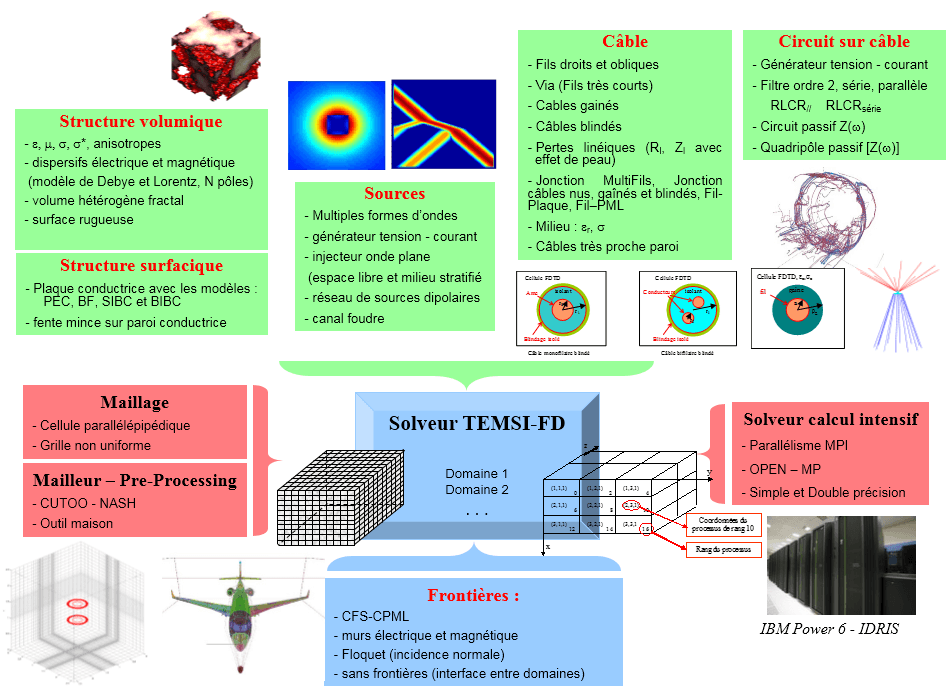
TEMSI-FD solver functionality
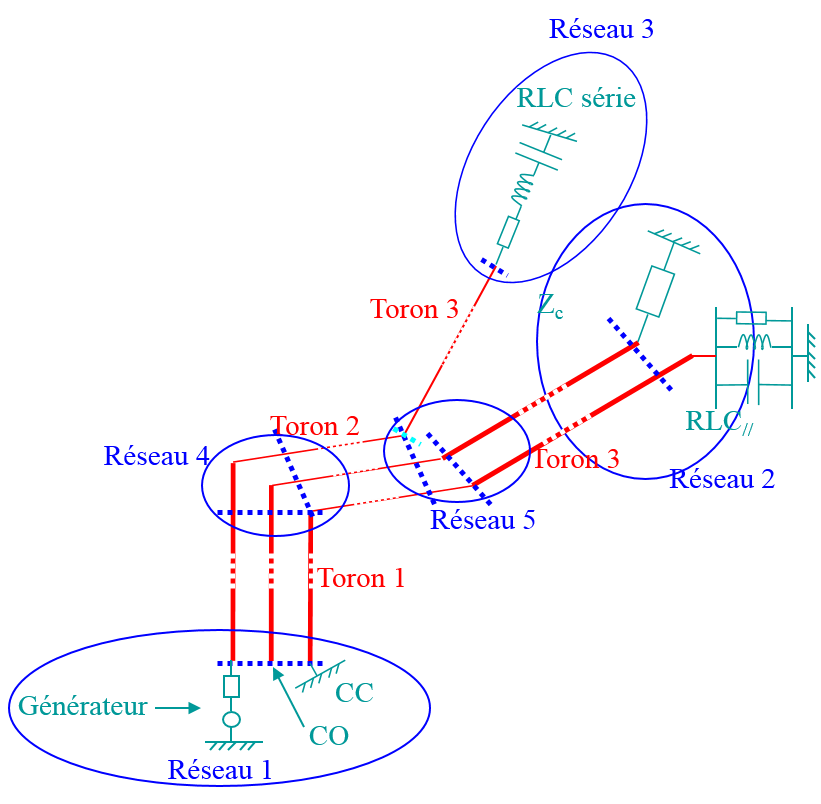
LAMLIM processing diagram
Test facilities
…