
ICONES
Head
David HELBERT
 david.helbert@xlim.fr
Secretariat
Laëtitia BARC
Sophie HARDOUIN
laetitia.barc@xlim.fr sophie.hardouin@xlim.fr
Staff
17 permanent staff, 16 PhD students, 1 postdoc, 1 master’s intern
Based in Poitiers, this team’s research activities are organised around the modelling and processing of colour and spectral information in images and videos. The issues addressed relate to theoretical questions and to applications in the fields of heritage, industry and multimedia in the broad sense. The scientific challenges revolve around measurement and analysis tools for multivariate images, composite measurements from multivalued images, and the modelling of multivalued measurements for decision-making and medical imaging.
Research themes:
The ICONES team’s research themes include measurement, acquisition, analysis, processing and decision support. The field of multivalued images includes colour images (perceptual and physical domains), multispectral and hyperspectral images, multimodal images (MRI for example) and multi-sensor images. They have a two- or three-dimensional spatial support, with or without a time dimension.
The issues addressed cover:
 the physical and continuous aspects of the observed scene (the object of interest),
taking the acquisition sensor into account,
the resulting mathematical and algorithmic aspects and the structuring of content,
the perceptual aspects related to the observer,
interpretation and decision-making.
“Computer vision” aspects cut across the team’s activities. In addition to its involvement in XLIM’s shared structures and being at the origin of the creation of the I3M joint laboratory, ICONES is also a co-founder of the CEMOP technology platform (Centre de Métrologie Optique Poitevine) in partnership with the PPRIME institute (CNRS UPR 3346).
Measurement and analysis tools for multivalued images
Since its creation, ICONES has been developing image-based measurement solutions. The properties measured range from the optical properties of surfaces and the motion of objects and fluids to the properties of the human visual system. ICONES has thus developed measurements of the physical constituents of a surface (roughness, reflectance, …). These are also at the heart of the measurement of material appearance through the analysis of microfacets and BRDF, in collaboration with the Image Synthesis theme of the axis.
For the study of unsteady fluid flows by 3D optical measurements (tomographic PIV), an algebraic reconstruction method (Bi-MART) and a stochastic reconstruction method based on marked point processes have been proposed. They have made it possible to take into account vibration problems during acquisition, astigmatism and refraction, and to carry out coupled fluid/structure measurements. Post-processing of the velocity fields has made it possible to estimate the instantaneous pressure and the forces around profiles in the flow.
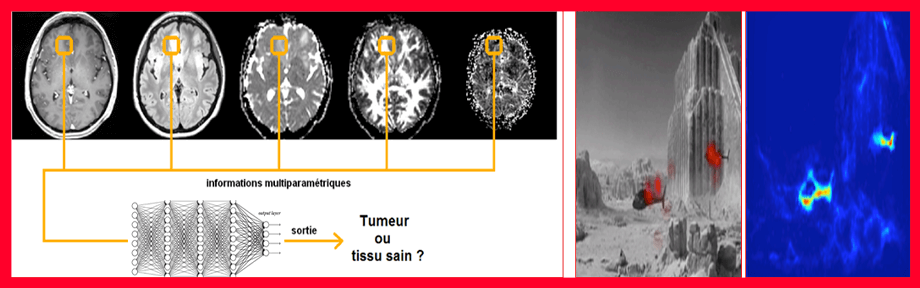
Regarding multivalued aspects, we designed a spectral difference measure that is valid from a metrological point of view and showed its added value in various satellite and heritage applications. We also looked at the inverse problem of estimating reflectance spectra from colour measurements. We sought to combine several MRI modalities for the pre-processing and analysis of gliomas, or for pre-processing and segmentation to assist in the diagnosis of AMD.
The human visual system has been studied to estimate its perception thresholds in the context of stereoscopic images. These results made it possible to define quality metrics applied to stereoscopic 3D images/videos. In parallel, we proposed various perceptual optimisation strategies for 3D-360° encoders for H.264 (AVC), H.265 (HEVC) and H.266 (VVC) video images, and perceptual adaptations of content and HDR images. Beyond perception, we have been interested in measuring behaviours and emotions. These emotion measurements have been applied to image retrieval.
This work in the field of colour perception and spectral physics is championed by members of the ICONES team within Division 8 of the International Commission on Illumination (CIE); ASALI is represented there by 4 members, one of whom serves as secretary of the division and as French representative to the CIE, two chair international technical committees and the fourth is liaison officer with ISO.
Composite measurements from multivalued images

The ICONES team contributes to building operators for measuring and analysing the composite aspects of an image, in particular those linked to its textured (non-uniform) appearance. These measurements require combining both the spatial dimensions (notably the geometric aspect) and the colour/spectral dimensions of images. ICONES is at the origin of the construction of a formalism for the local analysis of the phase of an image within the framework of a monogenic transformation of the multivalued signal. ICONES also links this question to metrology in perceptual and physical spaces. Texture is defined there as a joint probability between the distribution of the data and the distribution of the spatial variations of the multivalued data. This definition is generic and consistent with the literature; it is also consistent with the results of psychophysical experiments and with the definitions previously proposed in the literature. Its genericity is expressed in a single definition independent of the nature of the imager, extended to the hyperspectral context. In addition to linear or statistical approaches, we study graph-based strategies to provide analysis tools for wavelet-based image decompositions or decompositions based on polynomial representations. We also study the use of neural networks in conjunction with graphs (Graph Neural Networks) to deal with the complex geometric organisation of multivalued image content.
The metrological extraction of gradients in multivalued images has been studied from two different angles: morphological approaches and measurement in the sensor space. Both approaches are generic and independent of the number of acquisition channels and of their correlation. These results made it possible in particular to define the first interest-point detectors for multispectral and hyperspectral images that are valid from a metrological point of view.
Modelling of multivalued measurements for decision-making
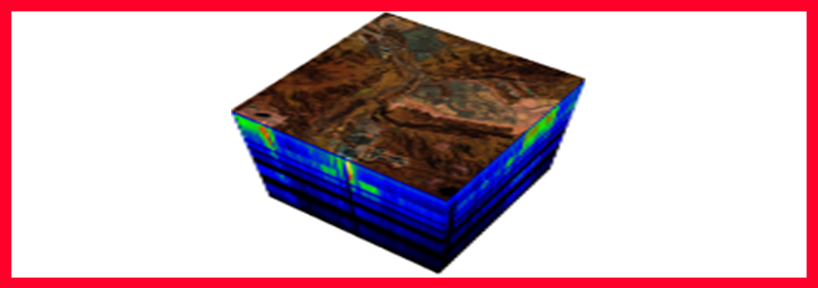
In the context of modelling measurements for decision-making, we are revisiting the interactions between data-driven and hypothesis-driven models. The construction of semantic reasoning and hypotheses is defined from criteria and calculation rules derived from a self-learning algorithm. More than an end in itself, optimising the performance measure then becomes an indicator of relevance. The hypotheses and criteria defined by learning are the real richness of the analysis through an intelligible visual representation of the content, which is one of the challenges ICONES is currently facing, particularly in the context of health issues.
Moreover, the proposed approaches optimise the description of data in a weakly supervised or even unsupervised manner. They are used to index data by fusing many descriptors. The main objective is to obtain a discriminating visual signature for each image.
We have also explored how to adapt a deep neural network for the classification of Magnetic Resonance Spectroscopy (MRS) data, for the detection and visualisation of regions of interest in MRI images, or for the identification of the best spectral sensitivity curves for hyperspectral image recognition.
Finally, in the context of security, we have proposed various strategies for detecting hidden data, notably through modelling based on belief functions and information-hiding methods using both advanced error-correcting code concepts for robustness and the modelling of the human visual system for invisibility.
The metrological extraction of gradients in multivalued images has been studied from two different angles: morphological approaches and measurement in the sensor space. Both approaches are generic and independent of the number of acquisition channels and of their correlation. These results made it possible in particular to define the first interest-point detectors for multispectral and hyperspectral images that are valid from a metrological point of view.
Medical imaging
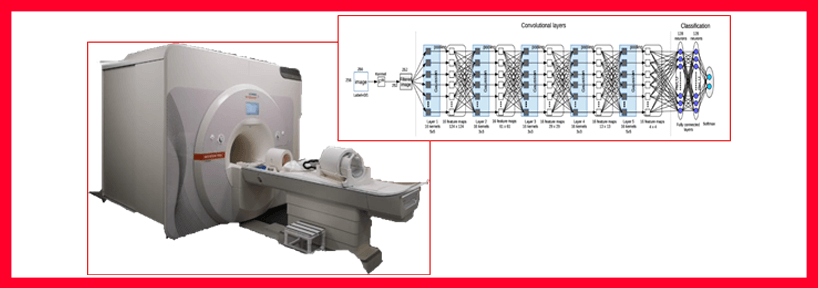
Since 2015, ICONES has been structuring its activity in the health field around medical imaging in a strategic collaboration with the Poitiers University Hospital. This collaboration is at the origin of the creation of the I3M joint laboratory and of many theses funded within this framework. I3M relies on a platform made up of two Siemens multi-nuclei very-high-field Magnetic Resonance Imaging (MRI) systems at the Poitiers University Hospital (3T and 7T MRI), giving access to very high-resolution anatomical and functional imaging, which looks at the function of organs, tissues or cells, that is, their metabolism. This metabolic imaging should lead to major advances in the in vivo, non-invasive study of many pathologies, in their clinical management and in monitoring their progression under treatment, possibly after surgery. Some results have been described previously; we complete them here to show the interactions. We have worked on optimising the pre- and intra-operative protocol for the management of Diffuse Low-Grade Gliomas (DLGG), and on defining criticality maps of DLGGs through multi-parametric MRI assessment.
Assisting the choice of kidney grafts is a major challenge of the project. A first level of assistance was produced from texture-based segmentation (IMPROVED regional project). In addition, an aid for the early diagnosis of Alzheimer’s disease was produced based on a method for exploring and classifying metabolic brain data by deep learning (1D CNN on raw spectroscopic data). This work is continuing through a project with the Memory, Resources and Research Centre of the Poitiers University Hospital. Finally, the joint laboratory enabled the recruitment of two PhD students in 2019 for kidney imaging, one thesis in the field of stroke treatment and two theses on neurodegenerative diseases.
Partnerships:
Bioalternative, Gencay, France – Canon Medical Systems, Suresnes, France – Caire, Vendôme, France – Chanel, Paris, France – Limoges University Hospital, France – Poitiers University Hospital, France – Colas, Paris, France – Cortex Productions, La Couronne, France – Coruo, Limoges, France – DOPI, Mauzé, France – Einden Studio, Châtellerault, France – Eurovia, Rueil-Malmaison, France – Geosiris, Fourqueux, France – Idem Santé, Chauray, France – Institut Gaspard Monge, Université Gustave Eiffel, Champs-sur-Marne, France – JULES SAS, Paris, France – CRISTAL Laboratory, ENSI, La Manouba, Tunisia – ICube Laboratory, University of Strasbourg, France – LIGUM Laboratory, University of Montreal, Canada – MICS Laboratory, CentraleSupélec, Paris, France – Chamber of Commerce and Industry of the Poitou-Charentes Region, France – LIRIS, University of Lyon, France – NOVO3D, Angoulême, France – NTNU – Norwegian University of Science and Technology, Trondheim, Norway – Orange, Paris, France – ONERA, Palaiseau, France – Panga, La Rochelle, France – Quadra Informatique, Phalempin, France – Rinnov, Chasseneuil du Poitou, France – Saint-Gobain, Paris, France – Siemens Healthcare SAS, Saint-Denis, France – Technicolor, Paris, France – University of West Attica, Athens, Greece – University of Girona, Spain – University of Granada, Spain – USTH – University of Science and Technology of Hanoi, Vietnam – AZM University, Tripoli, Lebanon
National and international research programmes :
ANR DigiPi (Digital Pigment: From colour in Cultural Heritage to industrial requirement in spectral metrology) – CRC Centre de Recherche sur la Conservation – 01/10/2016 – 31/12/2021- https://anr.fr/Projet-ANR-16-CE08-0010
ANR FILTER2 (Negative FILtering of video-protection contEnts) – Paris Police Headquarters, French Ministry of the Interior, GREyC (Research Group in Computer Science, Image, Automation and Instrumentation of Caen), UPS-IRIT Université Toulouse III Paul Sabatier, TCS THALES COMMUNICATIONS & SECURITY SA – 01/10/2016 – 30/09/2020 – https://anr.fr/Projet-ANR-16-CE39-0013
ANR HD WORLDS (Huge HD Worlds – Parametric procedural models for the representation of complex virtual worlds) – LIRIS CNRS (Computer Science, Image and Information Systems Laboratory), ICube – Unistra (Laboratory of Engineering, Computer Science and Imaging) – University of Strasbourg – 01/10/2016 – 30/09/2020- https://anr.fr/Projet-ANR-16-CE33-0001 / http://hdworlds.unistra.fr/index.php
ANR MISTIC (Models, Inference and Synthesis for Textures in Colour Images) – LMA (Laboratory of Mathematics and Applications), LIAS (Laboratory of Computer Science and Automation for Systems), LTCI Institut Mines-Télécom – Télécom ParisTech, UPDESCARTES-MAP5 (Applied Mathematics at Paris 5) – December 2019 – 48 months – https://anr.fr/Projet-ANR-19-CE40-0005
BPI France Kurio Eye – Design of a visual capture accessory for nomadic use (Bluetooth-connected) suited to tablets and mobile phones – 03/04/2015 – 31/10/2017
H2020 CORDIAL : Research and development of a compact drilling and fastening unit suitable for a range of standard 2 piece fasteners – Société Nationale de Construction Aérospatiale SONACA SA (Belgium) – 01/02/2017 – 31/01/2020 – https://cordis.europa.eu/project/id/738200/fr