
The AIMROD joint laboratory
AIMROD is a joint laboratory with BLOOM Lasers initiated in February 2025. High-power pulsed UV laser sources address many industrial markets such as drilling of electronic boards, production of microelectronic components, manufacturing of solar panels and cutting of electrodes for electric batteries. These sources are based on infrared (IR) pulsed lasers converted by nonlinear stages. The generation of IR pulses is currently the limiting point for the power of these sources, and therefore the subject that requires a research effort to go beyond the state of the art. In AIMROD, the company BLOOM Lasers and the XLIM laboratory are carrying out research on scaling up IR laser sources based on so-called “special” fibres with the potential to overcome current limitations. The objective is indeed to produce efficient, short amplifying fibres with a very large mode area in order to limit the nonlinear effects that are detrimental to peak power scaling, while avoiding the pitfall of transverse modal instabilities, a threshold phenomenon in average power that is particularly harmful to beam quality.

Philippe ROY
CNRS Research Director, XLIM, UMR 7252, CNRS, Université de Limoges 87000 Limoges, France Email: philippe.roy@xlim.fr
Philippe ROY is a CNRS Research Director 1st class, currently based at Xlim, a joint research unit between the CNRS and the universities of Limoges and Poitiers. He obtained his PhD from the University of Limoges in 1997, in High-Frequency Electronics and Optoelectronics, specialising in Electronic and Photonic Systems. His work mainly concerns the design and fabrication of innovative, hybrid optical fibres, often with a complex index profile, produced by stack-and-draw methods. He takes a holistic approach that covers the development of specific materials and extends to integration into systems, with the laboratory’s academic and industrial partners. For example, he has developed all-solid optical fibres with an aperiodic index profile that push back modal instability thresholds by reinforcing the single-mode character of propagation.

Julien DIDIERJEAN
R&D Director, Bloom Lasers, Cité de la Photonique, 11 Avenue de Canteranne, 33600 Pessac – France Email: julien.didierjean@bloom-lasers.com
A graduate of Sup’Optique in 2004, Julien Didierjean carried out a PhD at the Charles Fabry Laboratory of the Institut d’Optique on high-power lasers. He then worked for ten years at Fibercryst, where he contributed to the industrial transfer of crystal fibre technology, from laboratory demonstration to commercialisation. In 2018, he joined EOLITE as R&D Director and developed a collaboration with XLIM on amplifying fibres. In 2021, he took part in founding BLOOM Lasers, where he became R&D Director. He is co-author of more than 100 scientific papers and co-inventor of four patents. He has also taken part in the development of seven industrial laser products.

Baptiste LECONTE
R&D Engineer, Bloom Lasers, Cité de la Photonique, 11 Avenue de Canteranne, 33600 Pessac – France Email: baptiste.leconte@bloom-lasers.com
Baptiste Leconte obtained his PhD in 2016 at the Centre de Recherche sur les Ions, les Matériaux et la Photonique (CIMAP) in Caen, France. His doctoral research focused on neodymium-doped fibre lasers operating around 920 nm and on high-power blue light generation. He then joined the XLIM research institute in Limoges, France, as a postdoctoral researcher involved in various projects on flexible and rigid (VLMA) erbium-, thulium- and ytterbium-doped fibres for high peak power and high energy applications. In 2023, Dr Leconte joined Bloom Lasers in Bordeaux as an R&D engineer. He is currently seconded to XLIM through the AIMROD joint laboratory, where he is in charge of the experimental development of innovative fibres synthesised using the “suspended powder” technology.

Emma MARTIN
Research Engineer “Materials Synthesis”, XLIM, UMR 7252, CNRS, Université de Limoges 87000 Limoges, France Email: emma.martin@unilim.fr
Emma Martin is a research engineer in the Photonics team of the XLIM laboratory, within the AIMROD joint laboratory. A graduate of ENSIL-ENSCI in 2021, specialising in industrial ceramics, she continued with a PhD at IRCER (Ceramics Research Institute) in Limoges. Her thesis work focused on the synthesis of doped calcium phosphate ceramics and their shaping by additive manufacturing. At the end of 2025, she joined the XLIM laboratory as a research engineer. She is notably in charge of synthesising fibre-drawing preforms using the “suspended powder” technology. Her current work focuses on developing new compositions and optimising this technology for producing ceramic preforms intended for fibre drawing.

Raphael JAMIER
Academic (Associate Professor, Hors Classe) at the University of Limoges
Raphael JAMIER is an academic (Associate Professor, Hors Classe) at the University of Limoges, based at XLIM since 2008. He has co-supervised 9 theses, including 5 CIFRE theses, 2 of which are currently ongoing. He is co-author of more than 50 journal articles and has been scientific leader of several ANR and European projects. His research covers the modelling, fabrication and characterisation of unconventional optical fibres for applications related to the handling of high optical powers in continuous or pulsed regimes.
The AIMROD roadmap
- Axis 1 (priority): Towards the ideal Rod for power scaling: target 400 W IR / 150 W in the UV
- Axis 2: Flexible large-mode-area fibres for compact and cost-effective sources
- Axis 3: Functionalisation of rod-type fibres: towards monolithic sources
- Axis 4: Advanced materials for innovative optical fibres
– Development #1.2 : Design and optimisation of structures that enhance the rejection of high-order modes, addition of high-index inclusions to promote delocalisation of high-order modes, depressed-index cores
– Development #1.3 : Design and fabrication of rod-type fibres with strong polarisation maintenance or even single-polarisation guidance
– Development #1.4 : Study and realisation of tapered rod-type fibres (« taper ») to push back the TMI threshold
Target markets : Drilling of electronic boards, photovoltaics, glass engraving. These markets require short nanosecond pulses ( 5 ns) with high energies ( 100-300 µJ) for process quality, and their productivity depends on the power of the laser source.
– Development #2.2: Design and fabrication of flexible large-mode-area fibres for femtosecond-regime preamplifiers: reduction of self-phase modulation through structural and/or chemical optimisation of the fibres
_ Development #2.3: Realisation of laser architectures based on flexible fibres from the previous developments as the main amplifier, aiming at 600 W in the IR to reach 200 W in the UV at high repetition rate (>50 MHz)
Target markets : Semiconductor machining, electrode cutting for batteries. These applications require very high average powers at very high repetition rates to reach extreme productivity.
– Development #3.2 : Optimised cooling of fibres through innovative solutions such as the use of metal solders with high thermal conductivity
– Development #3.3 : Design and realisation of fibre components that also make it possible to inject the pump through a fibre input spliced to the rod, towards a fully monolithic solution
– Development #3.4: Design and realisation of fibre components that make it possible to inject the laser signal through a fibre input spliced to the rod
Target markets : This axis reinforces the technology developed in axis 1 and serves the same markets.
– Development #4.2 : Study and synthesis of glasses with very low photodarkening to counterbalance the increase in ytterbium doping and/or reduce the thermal load along rod-type fibres
– Development #4.3: Design and synthesis of core materials for reducing or even cancelling the thermal expansion of the glass (thermo-optic coefficient dn/dT) by co-doping with phosphorus and boron ions : a disruptive technology for average power scaling
Target markets : This axis serves the other three and potentially serves all of BLOOM’s markets.
The very first AIMROD results, axis by axis …
Axis 1: Towards the ideal Rod for power scaling: target 400 W IR / 150 W in the UV
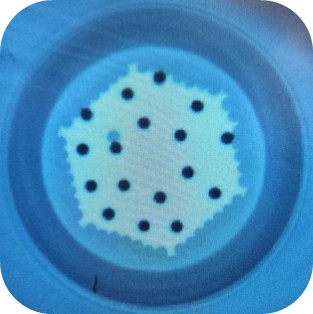
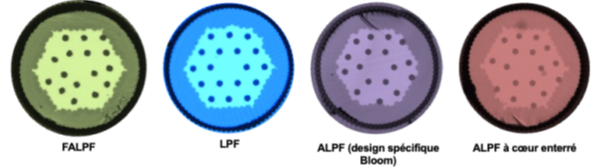
Examples of rigid fibre designs fabricated and compared :
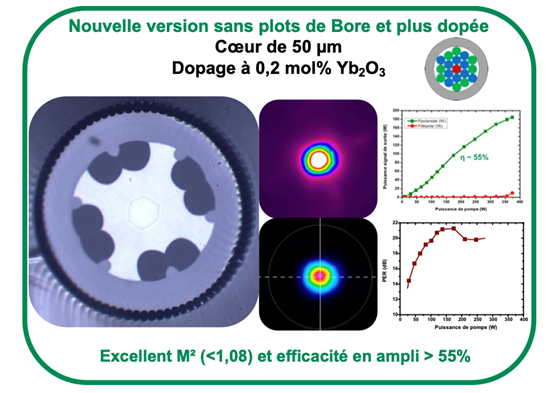
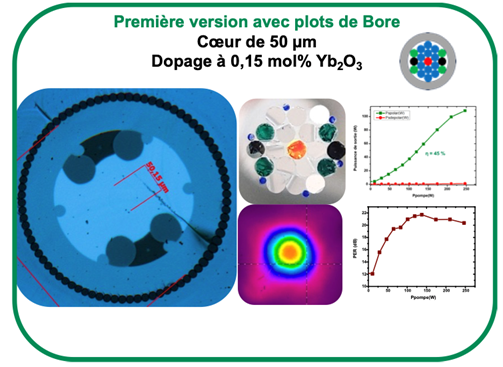
Example of a “ cost effective ” fibre dedicated to high-efficiency, high-power preamplifiers :
Example of a polarisation-maintaining fibre produced :
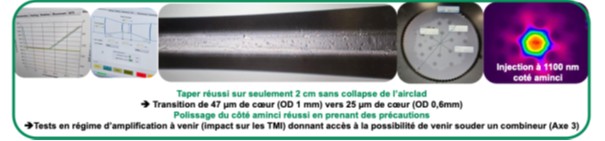
Example of a taper produced in order to improve laser integration. The taper will make it possible to splice the seeder to the power amplifier.
Axis 2 : Flexible large-mode-area fibres for compact and cost-effective sources
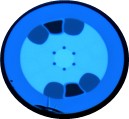
Examples of flexible fibres produced for preamplifiers

Axis 3 : Functionalisation of rod-type fibres : towards monolithic sources
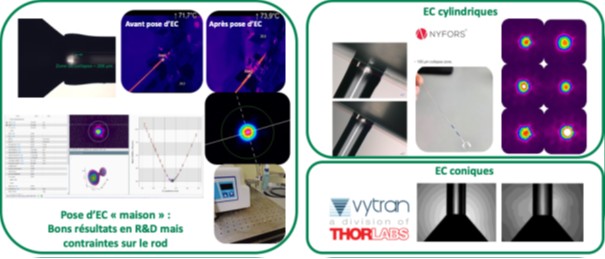
End-cap splices made with two types of CO2 splicers:
Axis 4 : Advanced materials for innovative optical fibres
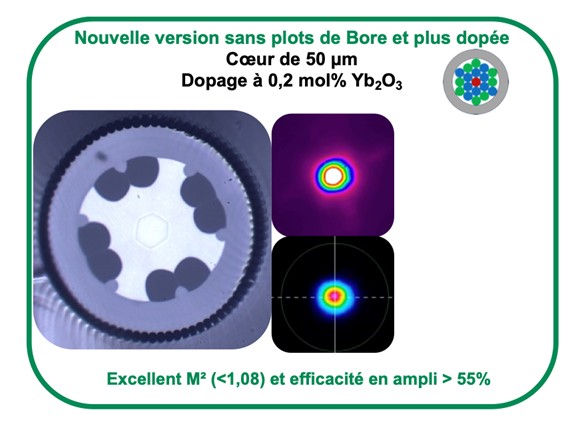
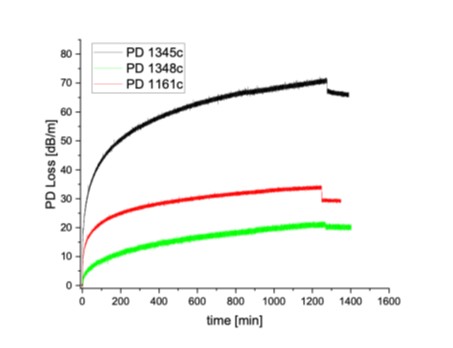
Boron-codoped silica glasses were successfully synthesised and these glasses demonstrated their ability to reduce photodarkening.