
PhoCaL
Head
Vincent KERMENE
 vincent.kermene@xlim.fr
Secretariat
Nathalie BUISSON
nathalie.buisson@xlim.fr
Staff
12 permanent staff
6 PhD students
5 postdocs
Overview
The research activities of the PhoCaL team fall within the general framework of mastering optical propagation in complex media. Our approaches use coherent optics and Fourier optics as a common vector, serving the control of coherence in complex media and systems (multimode waveguides, parallel or tree-structured multichannel fibre structures…). In this context, our activities have a strongly multidisciplinary character, covering the fields of nonlinear optics, imaging and lasers.
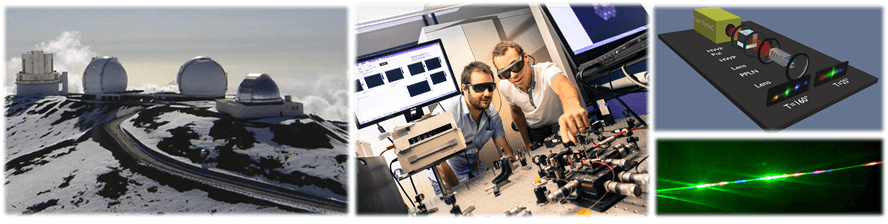
The team is interested in the interactions of light with nonlinear media such as optical fibres and crystals, in frequency conversions and innovative methods for astronomical imaging, and in the control and structuring of laser emission.

Research topics
Structured light and dedicated photonic systems
 Contacts: agnes.desfarges-berthelemot@xlim.fr | vincent.kermene@xlim.fr
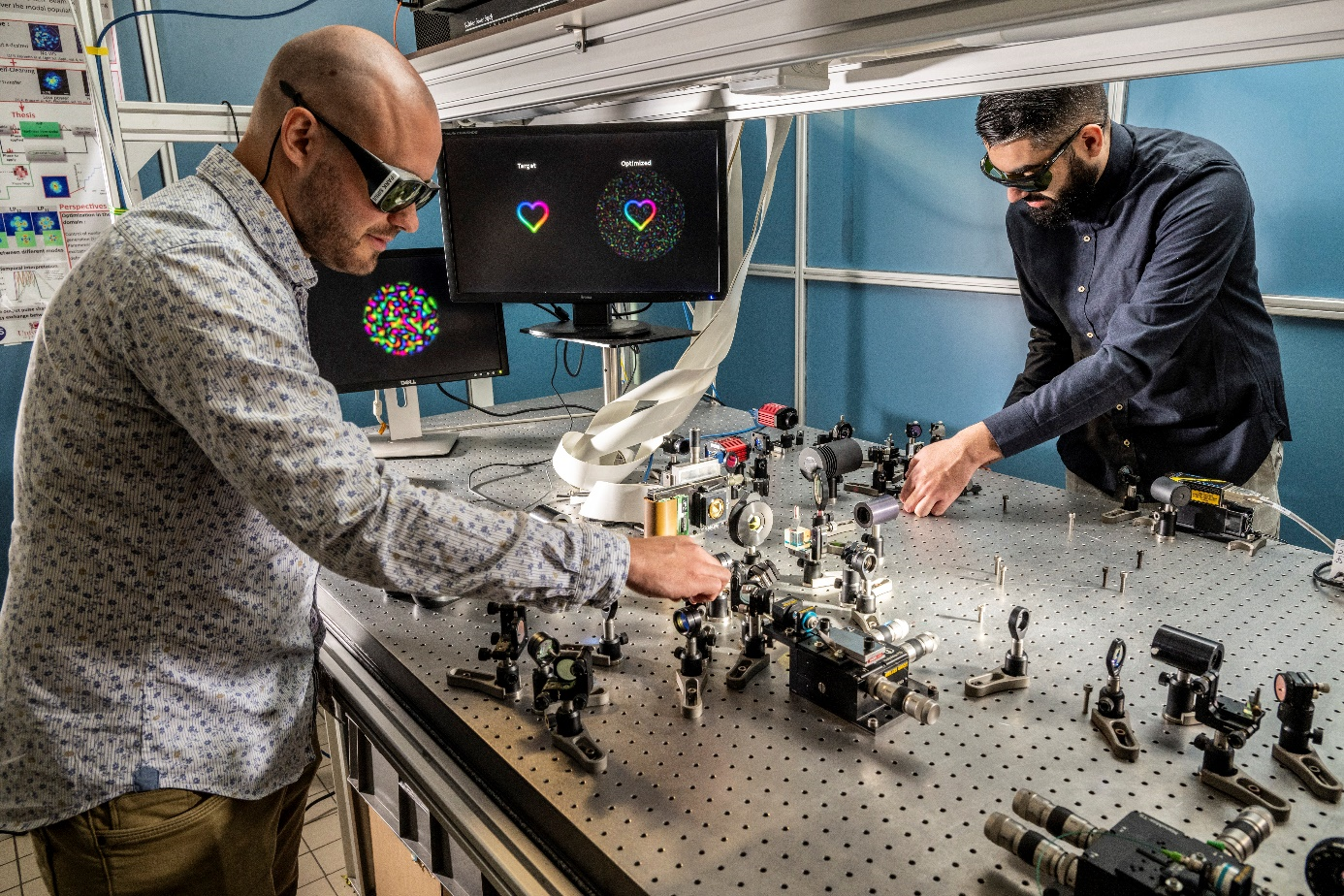
This research theme deals with the development of photonic systems and associated algorithms for the controlled structuring of coherent radiation through complex media: random, multimode, arrayed, amplifying and/or nonlinear. This work combines algorithmics and advanced experiments along the following main axes:
Coherent combining & arrayed laser architectures
We design new arrayed laser and amplifier architectures aiming at high power levels. This includes developing methods for analysing and correcting multi-pupil wavefronts for the coherent combining of laser beams. Up to 100 beams have been combined experimentally [1].
Agile laser sources with multimode amplifying fibres
We develop agile laser sources based on large-core multimode fibres, for both continuous-wave operation and ultrashort pulsed operation. Spatial and/or temporal beam profiling, including in the saturated-gain regime, is ensured by adaptive algorithmic approaches or neural networks.
Machine learning of coherent propagation models in complex media
We use machine learning approaches, without a reference wave, to recover, in the form of transmission matrices or neural networks, the transform induced by the propagation of coherent radiation in highly multimode fibres or scattering media. These models are used to project 3D images through these components or to simulate a Kerr-type nonlinear spatial transform [2].
Wavefront analysis using an all-fibre optical system
We design fully fibre-based wavefront analysis devices, based in particular on the concept of photonic lanterns. These systems, modelled by neural networks, are applied to free-space optical communication, for the transmission/reception of signals with disturbed wavefronts.
Digital holography & bio-inspired microfluidics
We develop digital holography methods for the synthesis of 3D shapes in microfluidic circuits [3]. Part of this work is dedicated to the design of microphysiological chips (organ-on-chip) specifically adapted to the pharmacological research of the CBRS (Centre for Biology and Health Research).
—
[1] Experimental phase control of a 100 laser beam array with quasi-reinforcement learning of a neural network in an error reduction loop.
Shpakovych, M., Maulion, G., Kermene, V., Boju, A., Armand, P., Desfarges-Berthelemot, A., Barthélemy, A., 2021. Opt. Express 29, 12307.
https://doi.org/10.1364/oe.419232
[2] Machine learning-driven complex models for wavefront shaping through multimode fibers.
Saucourt, J., Gobé, B., Helbert, D., Desfarges-Berthelemot, A., Kermene, V., 2024. Optical Fiber Technology 88, 104017.
https://doi.org/10.1016/j.yofte.2024.104017
[3] Holographic photopolymerization combined to microfluidics for the fabrication of lab-in-lab microdevices and complex 3D micro-objects.
Lale, A., Buckley, C., Kermène, V., Desfarges-Berthelemot, A., Dumas-Bouchiat, F., Mignard, E., Rossignol, F., 2023. Heliyon 9, e20054. https://doi.org/10.1016/j.heliyon.2023.e20054
Research programmes
TALOS project of the European Defence Agency
MULTIMOC project of the ANR ASTRID
Nouvelle-Aquitaine Region projects (APLI, 3DEFI, ILAS)
University of Limoges exploratory project (MIMIC)
Labex SigmaLim project (I3DOC)
Partnerships
X-LAS joint laboratory (XLIM/CILAS)
Alphanov (optical & laser technology centre)
Onera/DOTA
IRCER UMR 7315
CBRS (NeurIT Neuropathies and therapeutic innovations UR 20218, Pharmacology & Transplantation UMR 1248 Inserm University Hospital)
Quantitative Optical Imaging
Contact: pierre.bon@cnrs.fr Dedicated website: https://www.quantitativeimaging.fr/home
We are interested in developing imaging & metrological methods, mainly label-free, to characterize any sample from a single virus to complex (meta)surface or living biological tissue. We are using both linear and non-linear processes.
We are focusing on 3 main pillars to do so:
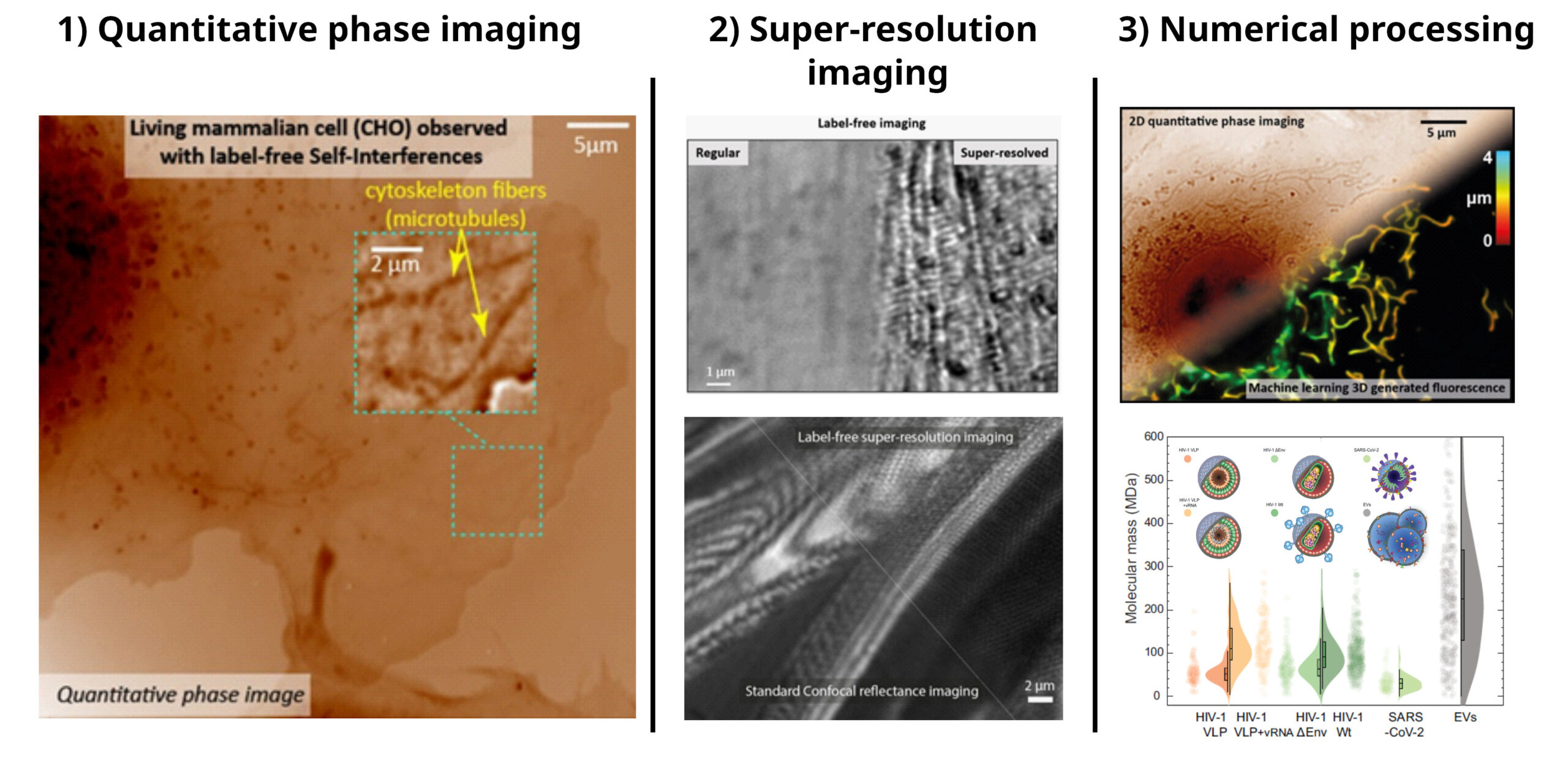
Quantitative phase imaging
We are expert in using self-interference methods to extract not only the intensity of the light but also its phase. We are applying this approach to quantify the thickness of structures but also to weight biological samples and to characterize nano-particles.
We are designing and realizing our own interferometer thanks to the PLATINOM facility in the XLIM institute.
Super-resolution methods
We are developing new imaging platforms and we are specialist in super-resolution imaging. We perform measurements on both sparse sample (3D super-localization of nanoparticles or fluorescent molecules) and dense (label-free) sample using photon-reassignment.
Our label-free super-resolution approach has led to the creation of the company IotaMetrix (https://www.iotametrix.fr/home).
Numerical processing
We are using direct signal processing methods as well as dedicated machine learning tools to perform our metrological analysis.
Thank to the co-conception between optical and processing methods, we can extract from our complex label free data important features to identify objects and characterize our samples.
Feel free to contact us if you want to collaborate or join the adventure!
[1] Label‐Free Single Nanoparticle Identification and Characterization in Demanding Environment, Including Infectious Emergent Virus.
Nguyen, M., Bonnaud, P., Dibsy, R., Maucort, G., Lyonnais, S., Muriaux, D., Bon, P., 2024. Small 20.
https://doi.org/10.1002/smll.202304564
[2] Nondestructive inspection of surface nanostructuring using label-free optical super-resolution imaging.
Aguilar, A., Khalil, A.A., Aldeiturriaga, D.P., Sedao, X., Mauclair, C., Bon, P., 2023. Sci Rep 13.
https://doi.org/10.1038/s41598-023-32735-w
[3] Quantitative phase microscopies: accuracy comparison.
Chaumet, P.C., Bon, P., Maire, G., Sentenac, A., Baffou, G., 2024. Light Sci Appl 13.
https://doi.org/10.1038/s41377-024-01619-7
Research programmes
- European: ERC StG “SpeciPhic” (2020-2026)
- National: ANR PRC “DynaMitoPatho” (2023-2027)
- INSERM Impulsion Project “MecaCell3D” (2023-2028)
- CNRS Pre-maturation “NanoInSitu” (2022-2023)
- Regional: NAQ Project “MetabOptique” (2023-2027)
Partnerships
- Institutional: LP2N, IBGC, Institut La Vision, IRIM/CEMIPAI, Institut Fresnel, Institut Curie
- Industrial : Myriade, IotaMetrix
Smart Nonlinear Photonics
Contact: benjamin.wetzel@xlim.fr
The Smart Nonlinear Photonics research theme is dedicated to the study and control of nonlinear dynamics in guided optics, with the ambition of designing smart photonic sources for advanced applications.
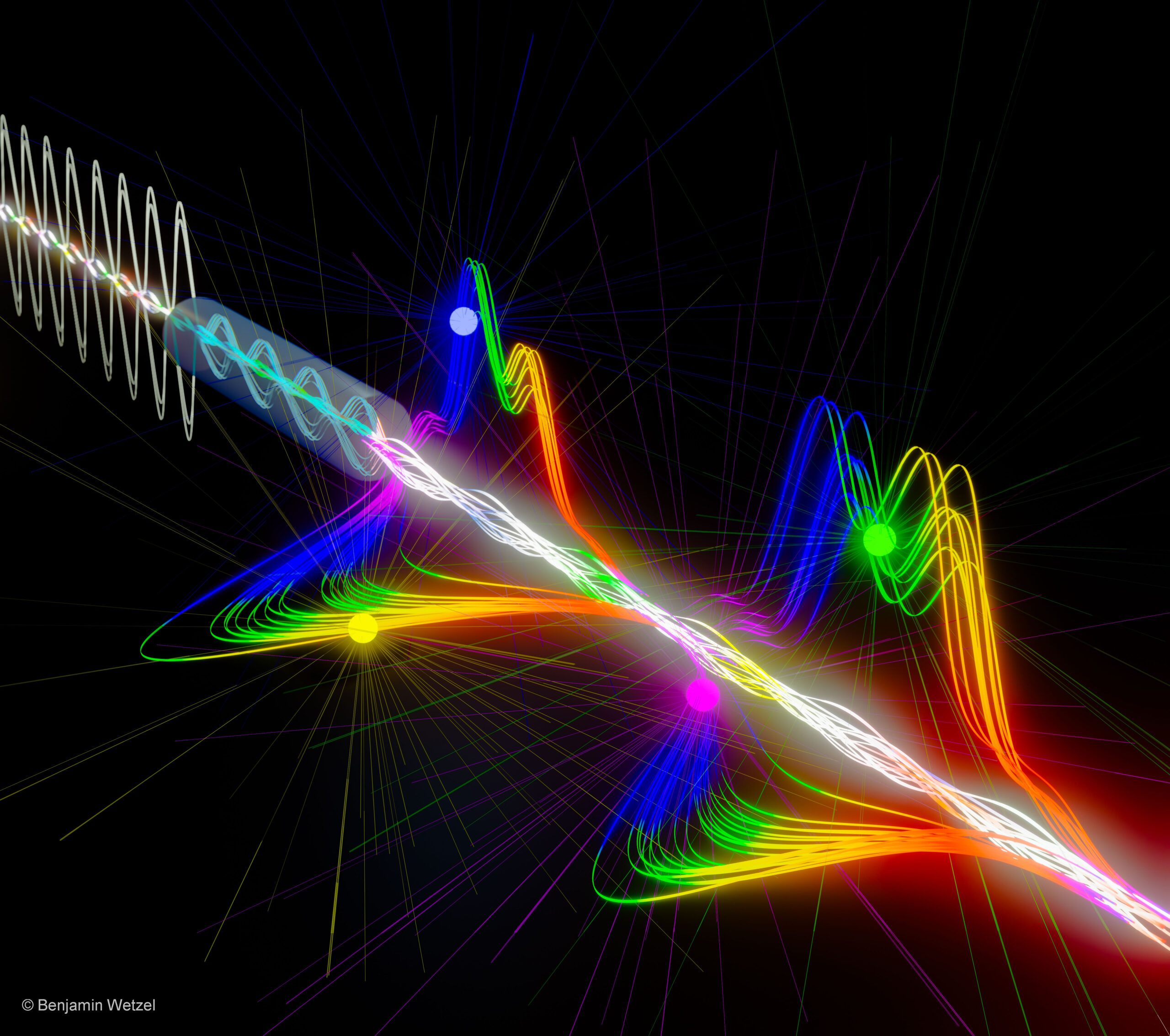
We explore complex phenomena related to the nonlinear propagation of ultra-short pulses (fs-ps) in a wide variety of fibre-based and integrated systems. Our work focuses on spectral broadening mechanisms (supercontinuum, optical frequency combs) and on the associated physical phenomena: emergence and collisions of solitons, modulation instability, noise dynamics, intermodal interactions, optical trapping, and more.
At the intersection of nonlinear optics, ultrafast photonics and artificial intelligence, our approach relies on state-of-the-art experimental platforms and on strong international collaborations, in a resolutely multidisciplinary spirit.
We design and implement advanced hybrid optical control methods, combining spectro-temporal engineering, spatial multiplexing, on-chip photonic devices and spectral shaping in the Fourier domain.
We also develop innovative measurement techniques capable of capturing the fine multidimensional structure of ultrafast, broadband optical signals: spectro-temporal measurements (FROG, asynchronous X-FROG) and dispersive Fourier transform (DFT) for real-time analysis of incoherent signals.
Finally, we integrate optimisation and machine learning approaches — neural networks, evolutionary and bio-inspired algorithms — to model, tune and control these complex dynamics.
Beyond fundamental advances, our research leads to cross-cutting applications, explored within the group or through collaborations, notably in multiphoton imaging, precision metrology and quantum optics.
More information: https://www.smartphotonics.net
—
[1] Modulation instability control via evolutionarily optimized optical seeding.
L. Sader, Y. Boussafa, V.T. Hoang, R. Haldar, M. Kues, B. Wetzel “” Nanophotonics, In Press (2025)
[2] Optimization methods for integrated and programmable photonics in next-generation classical and quantum smart communication and signal processing.
L. Di Lauro, S. Sciara, B. Fischer, J. Dong, I. Alamgir, B. Wetzel, G. Genty, M. Nichols, A. Eshaghi, D.J. Moss, R. Morandotti “” Advances in Optics and Photonics, In Press (2025)
[3] Single-Photon Level Dispersive Fourier Transform: Ultrasensitive Characterization of Noise-Driven Nonlinear Dynamics.
Sader, L., Bose, S., Kashi, A.K., Boussafa, Y., Haldar, R., Dauliat, R., Roy, P., Fabert, M., Tonello, A., Couderc, V., Kues, M., Wetzel, B., 2023. ACS Photonics 10, 3915–3928.
https://doi.org/10.1021/acsphotonics.3c00711
[4] Quantum key distribution implemented with d-level time-bin entangled photons.
Yu, H., Sciara, S., Chemnitz, M., Montaut, N., Crockett, B., Fischer, B., Helsten, R., Wetzel, B., Goebel, T.A., Krämer, R.G., Little, B.E., Chu, S.T., Nolte, S., Wang, Z., Azaña, J., Munro, W.J., Moss, D.J., Morandotti, R., 2025. Nat Commun 16.
https://doi.org/10.1038/s41467-024-55345-0
[5] Customizing supercontinuum generation via on-chip adaptive temporal pulse-splitting.
Wetzel, B., Kues, M., Roztocki, P., Reimer, C., Godin, P.-L., Rowley, M., Little, B.E., Chu, S.T., Viktorov, E.A., Moss, D.J., Pasquazi, A., Peccianti, M., Morandotti, R., 2018. Nat Commun 9.
https://doi.org/10.1038/s41467-018-07141-w
Research programmes
- 2025-2029: ANR (French National Research Agency) – PRC 2024 Project
“Versatile Integrated optical Supercontinuum sources through nOnlinear PulsE Compression” – VISOPEC Project (ANR-24-CE24-5082)
> C2N (Coord: E. Cassan), PhLAM (A. Mussot), XLIM (B. Wetzel) - 2021-2026: European Research Council (ERC) – Starting Grant (ERC-StG-2020)
“Smart phoTonic souRces harnEssing Advanced Multidimensional Light optimization towards machIne-learNing-Enhanced imaging” – STREAMLINE Project (GA 950618)
Horizon 2020 Programme (EU), Sole beneficiary (B. Wetzel, XLIM) - 2021-2025: Nouvelle-Aquitaine Region – ESR Project (regional co-funding)
“Sources Photoniques intelligentes pour l’Imagerie avaNcée et les Applications Lasers” – SPINAL Project - 2021-2025: ANR (French National Research Agency) – PRC 2020 Project
“Optimized on-demand ultrafast and broadband light sources using machine learnings” – OPTIMAL Project (ANR-20-CE30-0004)
> FEMTO-ST (Coord: J.M. Dudley), ICB (C. Finot), XLIM (B. Wetzel) - 2024: ANR LabEx ∑-LIM (ANR-10-LABX-0074) – 2023 call for proposals
“Reconfigurable photonic sources for innovative approaches to computational imaging”
> XLIM (Coord: B. Wetzel) + CRIBL and IRCER laboratories (Limoges) - 2024: ANR LabEx FIRST-TF (ANR-10-LABX-48-01) – 2023 call for proposals
“Flexible and reconfigurable optical frequency combs”
> XLIM (Coord: B. Wetzel), PhLAM (A. Mussot)
Partnerships
- Institut National de la Recherche Scientifique (INRS), Montreal (Canada)
- Institute of Photonics, Leibniz University of Hannover, Hanover (Germany)
- FEMTO-ST Institute, Université Marie & Louis Pasteur, Besançon (France)
- Emergent Photonics Research Centre, Loughborough University, Loughborough (United Kingdom)
- PhLAM Laboratory, Université de Lille, Lille (France)
- City University of Hong Kong (CityUHK), Hong-Kong (China)
- Centre for Nanosciences and Nanotechnologies (C2N), Université Paris-Saclay (France)
- Swinburne University of Technology, Melbourne (Australia)
- Interdisciplinary Carnot Laboratory of Burgundy (ICB), Université Bourgogne Europe, Dijon (France)
- Tampere University, Tampere (Finland)
- Sapienza University of Rome, Rome (Italy)