
Fibre Photonics
Head
Georges HUMBERT
 georges.humbert@xlim.fr
Secretariat
Marie-Laure GUILLAT
marie-laure.guillat@xlim.fr
Staff
7 permanent staff
9 PhD students
7 postdocs
The ‘Fibre Photonics’ team is recognised for proposing concepts and producing optical fibres outside any known standard, when pushing back boundaries requires specific technological development.
We have expertise at various strategic points of the value chain, including the numerical design and fabrication of microstructured optical fibres and associated complex components,
 Objectives: improving people’s safety, environmental monitoring and supporting the productivity of our industries are all broad contemporary challenges for which research and development of smart transducers and laser generators at new frequencies are decisive. The ‘Fibre Photonics’ team is united around nationally and internationally recognised expertise in the field of special optical fibres, which we propose to use to meet some of these needs.
Our major recent development consists in combining the spatial complexity of microstructured fibres with the diversity of materials and the high precision offered by chemical glass synthesis methods.
The projects/themes we are developing are the following:
Our research and its applications rely on a skills base consisting of:
Fibres and waveguides for high-power lasers
The team’s research in this area contributes to the power scaling of fibre laser sources, in particular in the pulsed regime, by proposing optical fibre architectures in which the area of the core doped with rare-earth ions (Dcore > 50 µm, doping with Yb3+ or Tm3+ for laser emission at 1 µm or 2 µm respectively) is increased while maintaining excellent quality of the emitted beam (close to the diffraction limit).
One of our specialities is the development (modelling, fabrication and integration into laser systems) of so-called “ rod-type ” optical fibres (outer diameter close to 1 mm) whose microstructured cladding exhibits a symmetry break (fibres called “ Fully-Aperiodic Large Pitch Fibres ”). Our developments also cover the integration of specific functions into this type of fibre architecture (PM fibres, PZ…).
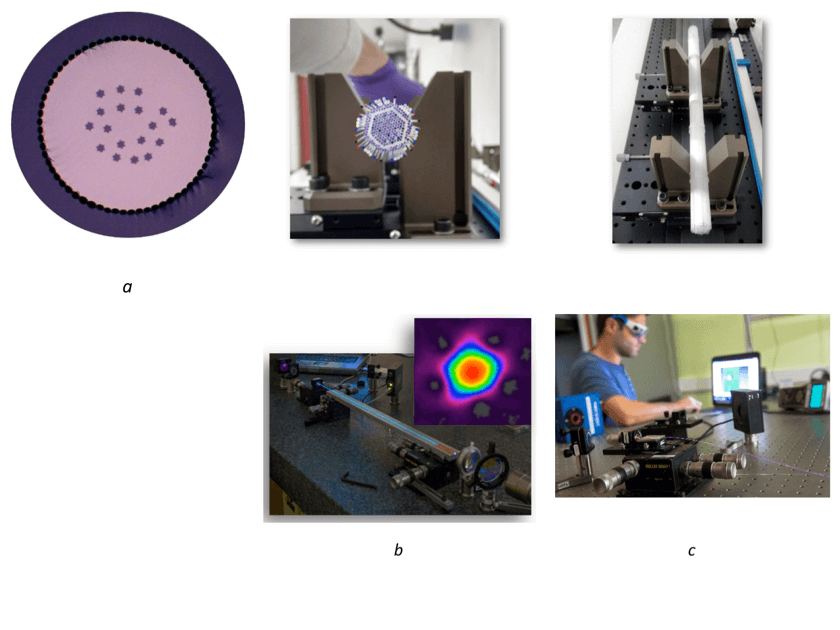
a : Input face of an aperiodic “ rod-type ” optical fibre (Dext = 1 mm)
b : 1.03 µm fibre laser based on an aperiodic “ rod-type ” fibre with a 50 µm core diameter (inset : near-field mode measured at the output)
c : 1.85 µm fibre laser based on a triple-clad fibre
and to go further:
[1] R. Dauliat, D. Gaponov, A. Benoit, F. Salin, K. Schuster, R. Jamier and P. Roy, “Inner cladding microstructuration based on symmetry reduction for improvement of singlemode robustness in VLMA fiber”, Optics Express, vol.21, n°16, p.18927, 2013
[2] A. Benoit, R. Dauliat, R. Jamier, G. Humbert, S. Grimm, K. Schuster, F. Salin and P. Roy, “Highly efficient higher-order modes filtering into aperiodic very large mode area fibers for single-mode propagation”, Optics Letters, vol. 39, n°15, pp.4561, 2014
[3] A. Benoit, R. Dauliat, D. Darwich, R. Jamier, S. Grimm, J. Kobelke, K. Schuster and P. Roy, “High-power fiber laser based on a non filamented-core fully-aperiodic large pitch fiber”, proceedings of Photonics West conference, paper n°9728-18, session 4, San Francisco (California, USA), 13-18 February 2016
Fibres and waveguides for femtosecond lasers
These research activities deal with the design and fabrication of specialty optical fibres for application to ultrafast all-fibre lasers either to scale the peak power or to operate at wavelengths not covered by conventional systems. This project has been funded by a number of research grants from the French National Research Agency (ANR) and from industrial partners. XLIM is a coordinator for the ANR-funded research program UBRIS2 (ANR-13-BS09-0018) whose fundamental goal is to propose innovative ways towards all-fiber ultrashort pulse lasers at long wavelengths (above 1.55 µm) through accurate fibre design. These all-fibre lasers find direct applications in micro-processing of soft materials, for example. Collaborative research with French and foreign laboratories is also conducted in order to apply this technology in various fields such as microscopy or spectroscopy. From 2017 onwards, XLIM is a partner of the ANR-funded research program BISCOT (ANR-16-BS09-0018) which aims at developing ultra-broaband mid-infrared supercontinuum sources by merging two hot scientific topics: the ultrafast all-fibre laser technology and the semi-conductor (AsGa) technology.

1700 nm femtosecond all-fibre format laser for deep bio-imaging. Left: measured optical spectrum. Right: autocorrelation trace.
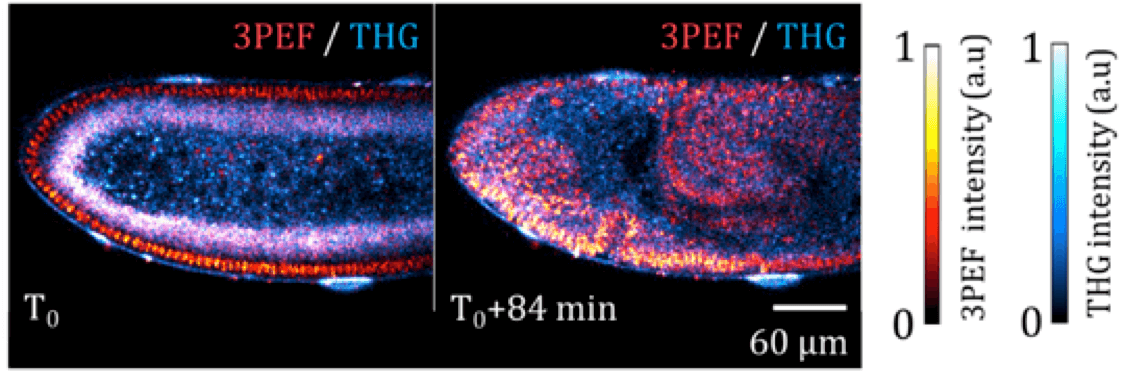
Snapshots of time-lapse three-photon-excited fluorescence (3PEF) and third-harmonic generation (THG) movies of developing Drosophila embryos with RFP labeling of cell nuclei. Left: THG and 3PEF overlay images of the embryo before the onset of gastrulation. Right: same embryo 84 minutes later. Anterior pole to the left, dorsal side up. Scale bar 60 µm. Pixel dwell time 27 µs.
Transducer fibres / sensors
Modifying the optical guide, the material it is made of, or adding nanoparticles makes it possible to produce transducer optical fibres, i.e. fibres that guide light while being sensitive, along their length, to the parameter to be measured.
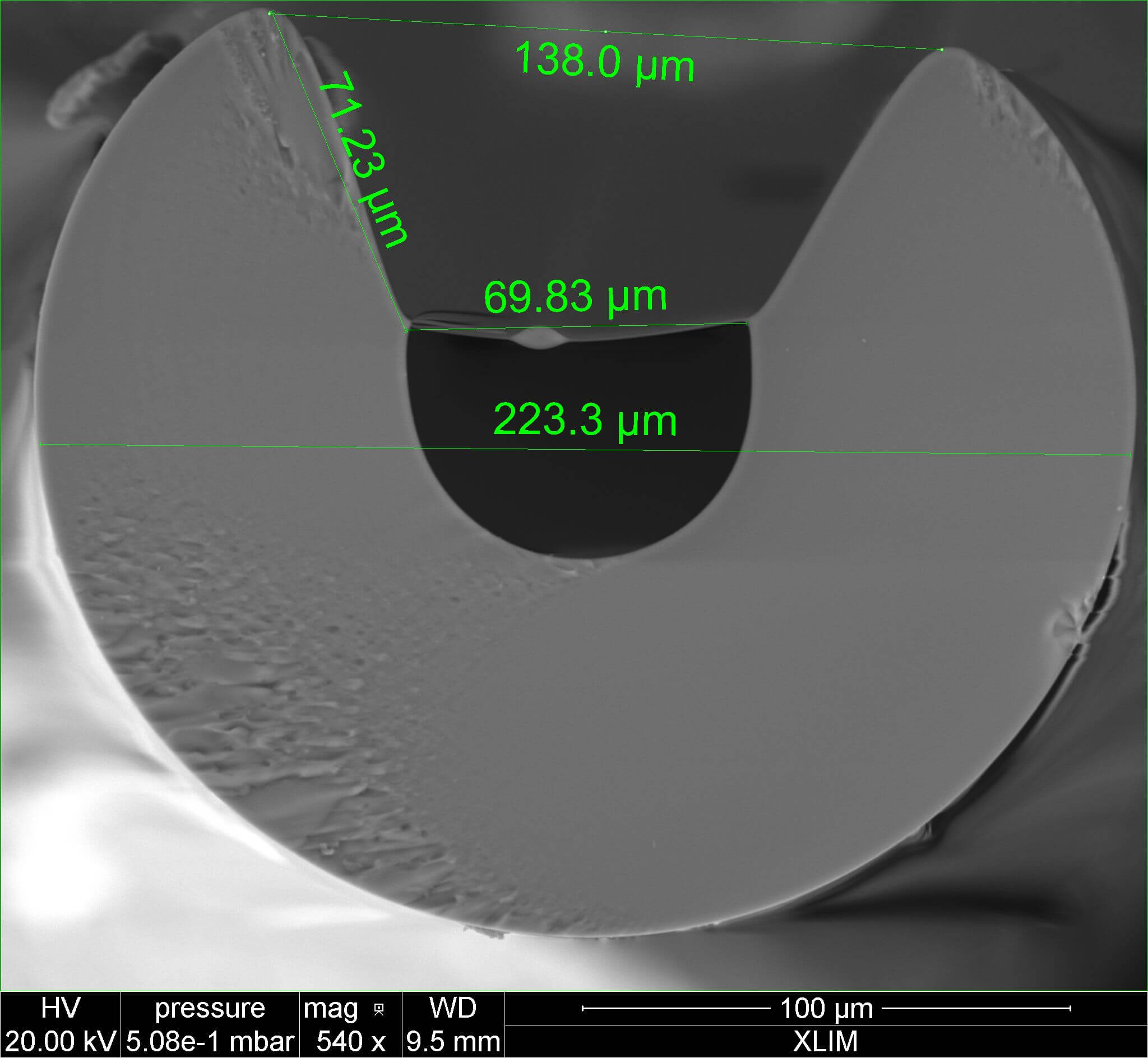
Micrometric suspended-core fibre:
Application to gas detection on decomposing coal tips – SUDOE ECOAL-MGT project

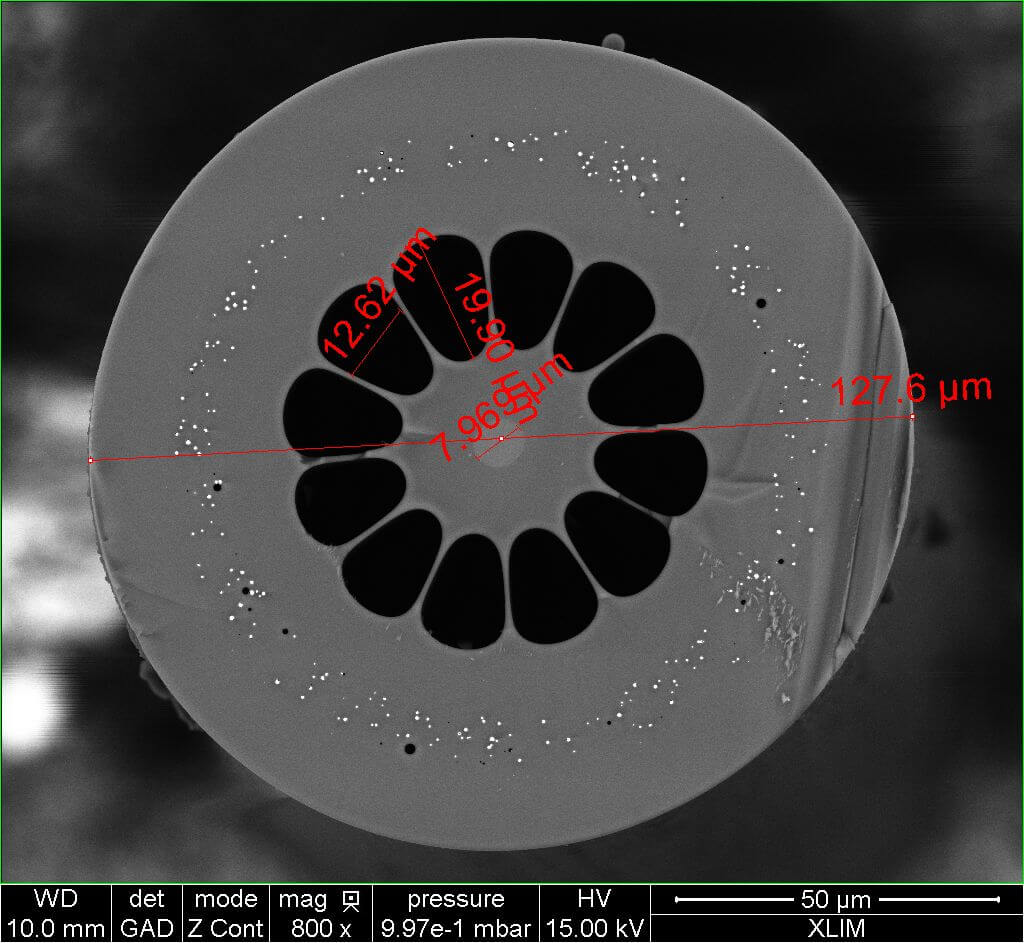
Microstructured fibre with a large interaction surface:
Application to biological cell counting – collaboration with CINTRA Singapore
Fibre including palladium nanoparticles:
Application to hydrogen detection – ANDRA collaboration – European project Modern2020
and to go further:
TeraHertz waveguides and components

Modelling of non-standard fibres via:
- Commercial software (COMSOL)
- in-house software – simulation of gain in optical amplifiers, chromatic dispersion, nonlinear optics …
In addition to conventional methods for fabricating preforms (Stack and Draw, present in the laboratory for more than 15 years) and producing optical fibres (low- and high-temperature drawing towers covering the 150°C-2000°C range), the Fibre Photonics team has developed a preform fabrication process based on the use of materials in powder form. This process, inherited from the 1970s and recently used by the teams of Clemson University (J. Ballato) and the company Silitec in Switzerland, has been adapted to our needs and complements the other existing techniques. This vitrification bench, developed in collaboration with Silitec, makes it possible to consolidate powdery materials, under atmosphere, before the drawing step.
This method is divided into two phases:
a. Materials synthesis:
The team has a glass synthesis laboratory, with an 1800°C elevator furnace, equipment that complements that of the SPCTS, with which the team works closely on all of these materials topics.
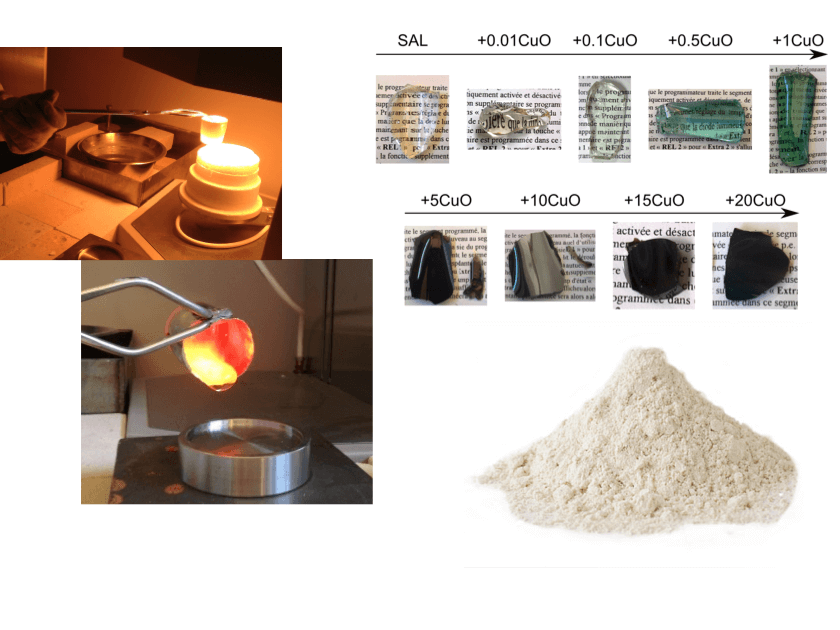
b. Preform consolidation and drawing:
The preform made of silica tubes and capillaries is filled in the chosen areas with the material (glass, metal, ceramic …) in powder form. This preform is then consolidated – partial or total vitrification of the powders – and drawn into an optical fibre.
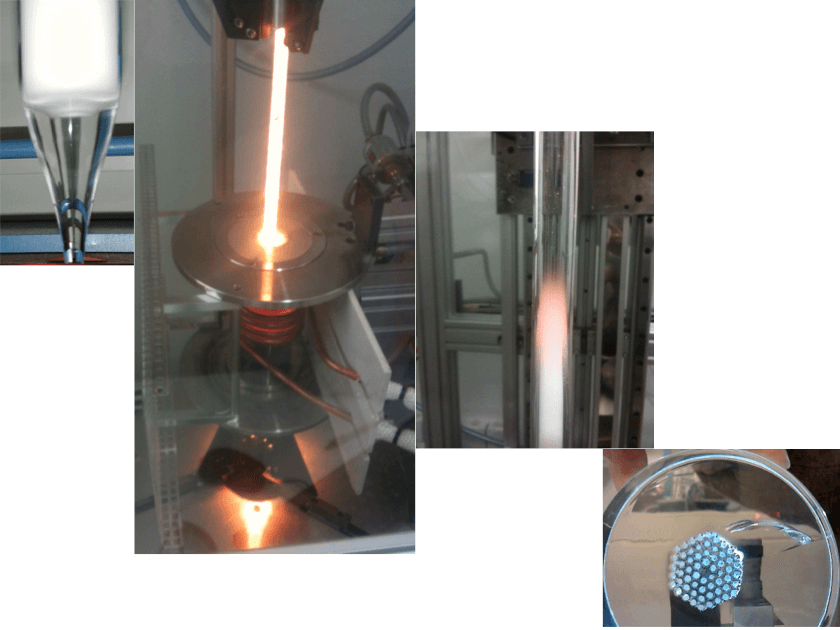
and to go further:
3. Innovative materials for photonics
Our glass synthesis equipment, combined with the skills and resources of the SPCTS, allows us to work with many glass matrices:
Pure silica, doped or undoped
Tellurite
Silica glass …
and this combined with the laboratory’s drawing facilities (low-temperature and high-temperature tower – 150°C – 2000°C)