
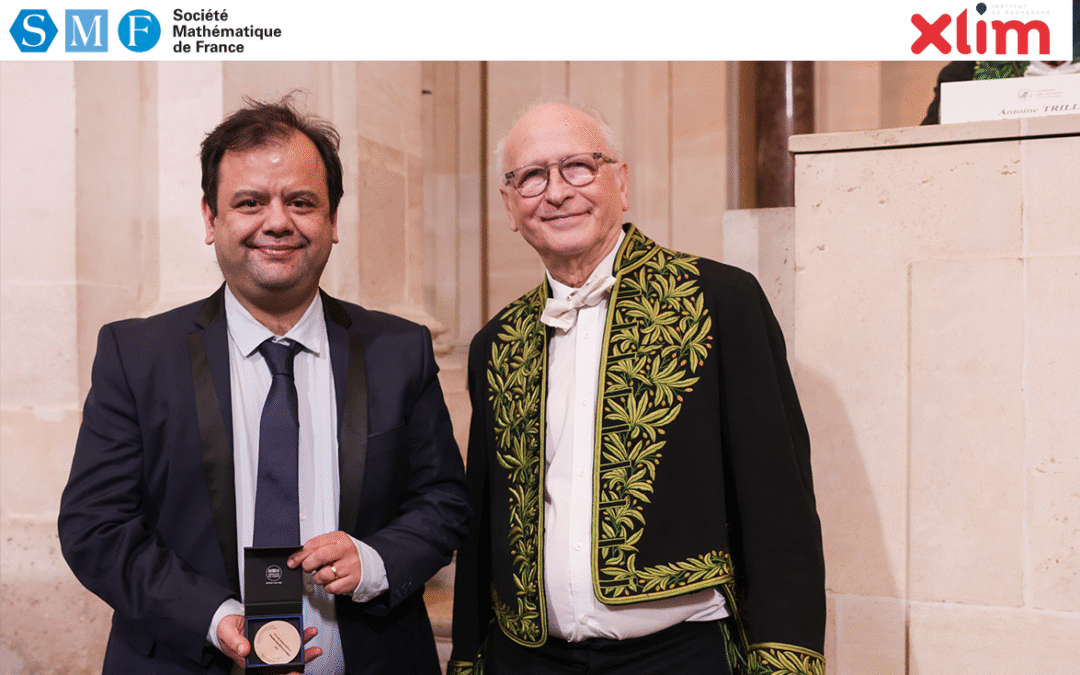
Francisco José Silva Alvarez wins the Jean‑Jacques Moreau Prize
On 25 November 2025, at a prestigious ceremony held at the Institut de France, Francisco José Silva Alvarez, Associate Professor at the XLIM Institute (University of Limoges), was awarded the Jean‑Jacques Moreau Prize.
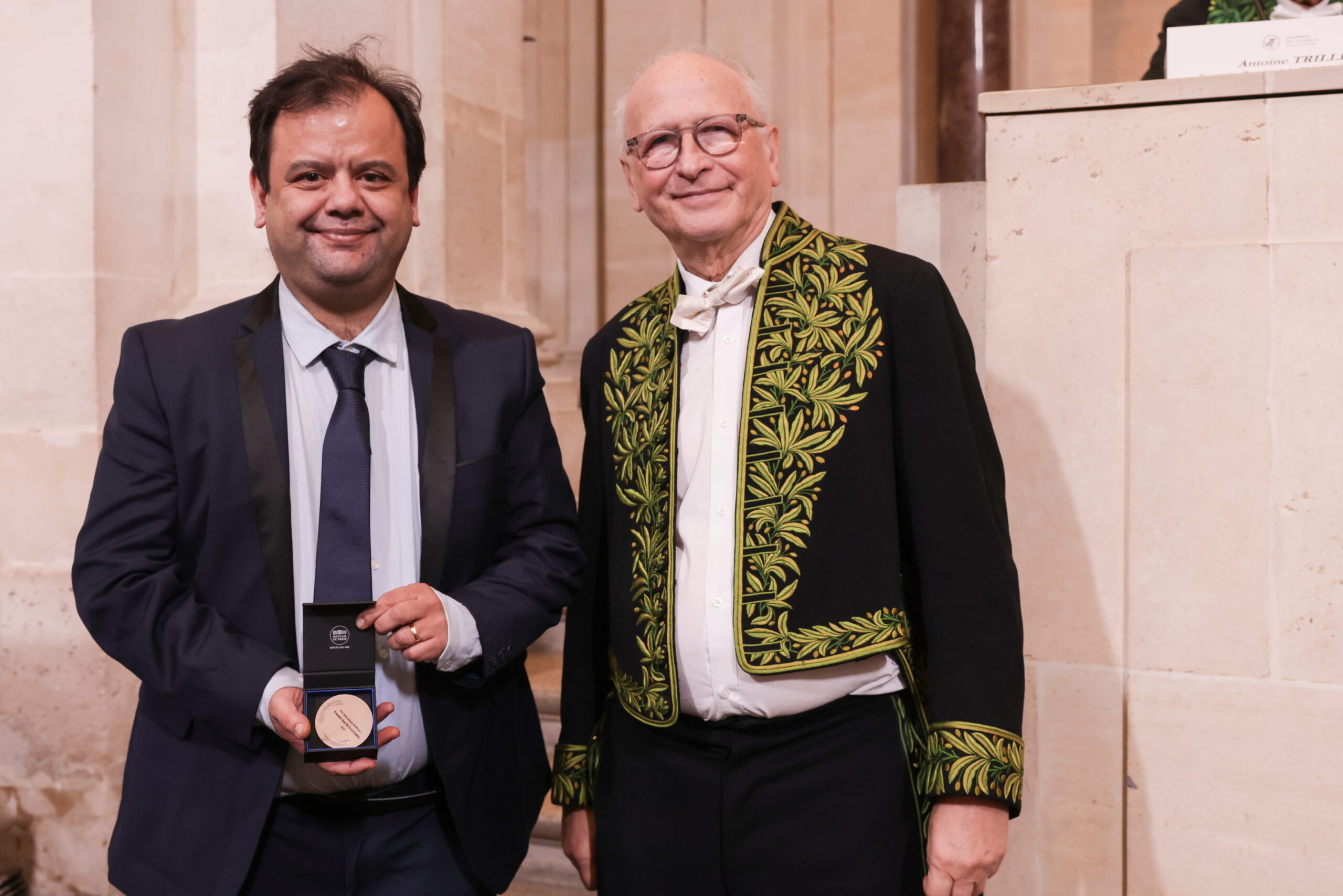
Francisco José Silva Alvarez conducts research on the optimisation of deterministic and stochastic trajectories and their numerical analysis. He is also interested in mean field games, in order to better understand collective behaviour in large interacting systems.
This prize rewards his remarkable contributions to optimal control, to the control of partial differential equations (PDEs) and to stochastic control, as well as to mean field games. His recent work notably establishes the convergence of discretisation schemes for mean field games in singular settings, providing reliable numerical approximations of equilibria for particularly complex problems.
Sponsored by the Société Mathématique de France (SMF), the Jean‑Jacques Moreau Prize is awarded in partnership with the Society for Applied and Industrial Mathematics (SMAI) and the Académie des sciences, and recognises every two years researchers in decision mathematics and optimisation.
Photo credits: ©Académie des sciences – Mathieu Baumer
Travaux de recherches
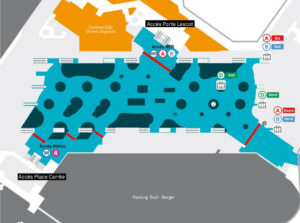
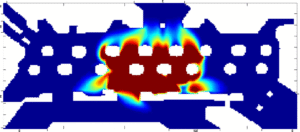
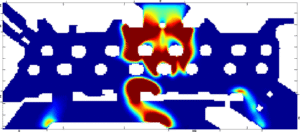
These two illustrations model the dynamics of a group of people (the red group) who are at the Les Halles station in Paris and who are trying to leave the station in an optimal way while taking congestion effects into account. Two cases are considered:
the first corresponds to the structure of the station in 2014 and the second to that of 2016 (after restructuring).
 |
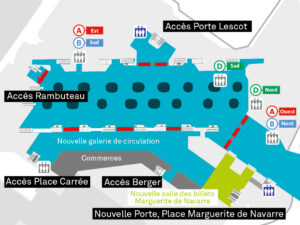 |
| 1st case: structure of the station in 2014. | 2nd case: structure of the station in 2016 (after restructuring). |
Illustration of the results of the 1st case:
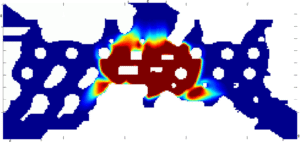 |
For the first case: this figure shows the initial configuration of the group of people. |
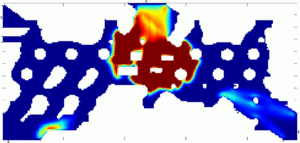 |
For the second case: the figure shows the configuration at a later time and shows how the group of people heads towards the exits. |
Illustration of the results of the 2nd case:
 |
 |
Carlini, E., Festa, A., Silva, F.-J. and Wolfram, M.-T. Semi-Lagrangian scheme for a modified version of Hughes model for pedestrian flow. Dyn. Games Appl. 7 (2017), no. 4, 683-705
Hughes LR (2002) A continuum theory for the flow of pedestrians. Trasp Res B Methodol 36(6):507–535