XLIM Research | The metal-insulator transition for the benefit of photocatalysis
A major advance in photocatalysis: vanadium dioxide opens a new path for the selective conversion of methane.
Efficiently transforming methane using light is one of the major challenges of modern photocatalysis.
A team of researchers from the Institute of Electronics, Microelectronics and Nanotechnology (IEMN – CNRS/University of Lille/Junia/Centrale Lille/Université Polytechnique Hauts-de-France) and the Unit of Catalysis and Solid-State Chemistry (UCCS – CNRS/University of Lille/Centrale Lille/Université d’Artois), in collaboration with the XLIM laboratory (CNRS/University of Limoges), the Institute of Research on Ceramics (IRCER – CNRS/University of Limoges) and the LPEM (ESPCI/CNRS/PSL/Sorbonne University), now demonstrate a radically new approach, based on exploiting the insulator–metal transition of vanadium dioxide (VO₂), making it possible to reach unprecedented performance and selectivity.
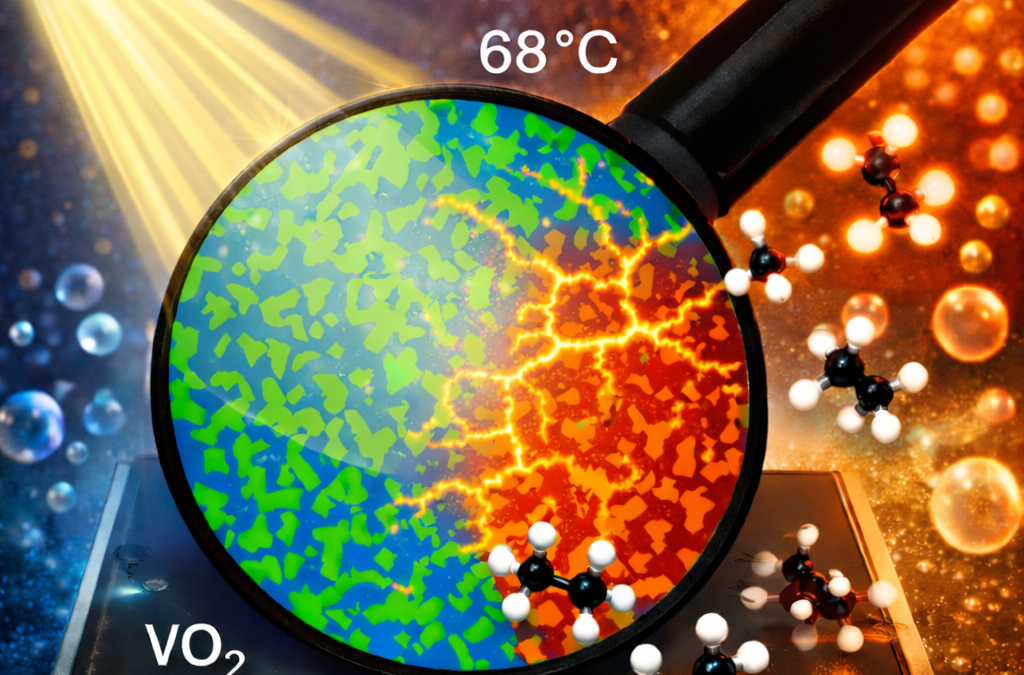
The efficiency of a photocatalyst in a chemical reaction depends not only on its ability to absorb light, but also on its capacity to transfer photo-induced charges to its surface. One solution to avoid the loss of these charges before they reach the surface relies on creating electronic junctions within the photocatalyst. By taking advantage of the network of junctions that is naturally generated in vanadium dioxide (VO2) when this material undergoes a metal-insulator transition, a record photocatalytic conversion of methane into dihydrogen, ethane and propane was obtained from VO2 thin films. Reducing the film thickness to less than 50 nm makes the reaction selective for propane, making this approach a promising and much less polluting alternative to the industrial fractionation of natural gas.
More information here: https://www.insis.cnrs.fr/fr/cnrsinfo/la-transition-metal-isolant-au-benefice-de-la-photocatalyse