
Antennas & Signals
Head
Cyril DECROZE
 cyril.decroze@xlim.fr
Secretariat
Marie CELERIER
Patricia LEROY
marie.celerier@xlim.fr patricia.leroy@xlim.fr
Staff
17 permanent staff, 22 PhD students, 6 postdocs, 1 master’s intern
Overview
The Antennas & Signals team carries out research on new architectures and technological solutions to address the advanced functionalities of antenna systems (agility, efficiency, …), in the fields of telecommunications, radar and space.
The work aims to provide an alternative to conventional solutions, to simplify RF architectures (reactive parasitic element array topologies, compressive multiplexing, optically controlled systems, …), by combining technological solutions in the search for efficiency and enabling a move up in frequency (front-end co-design, specific materials: VO2, ferroelectrics, ceramics).
Research themes:
 Architectures for multi-antenna systems
Co-design methods for the synthesis of RF functions
Miniature antennas and development of reconfigurable solutions based on innovative materials
Architectures for multi-antenna systems
For the needs of beamforming telecommunication systems, current antennas require a large number of radiating elements, and therefore very complex, bulky beamformers with reduced efficiency. To overcome these obstacles, the team proposes disruptive analogue architectures that favour stimulating and exploiting inter-element couplings rather than minimising them. In this framework, antennas with reconfigurable parasitic elements are being developed, offering antennas with a reduced number of RF channels, at the boundary between conventional arrays and sparse arrays. In addition, the antenna matching can be managed dynamically (active VSWR management), which opens interesting prospects for building a complete front end, including the active channels.
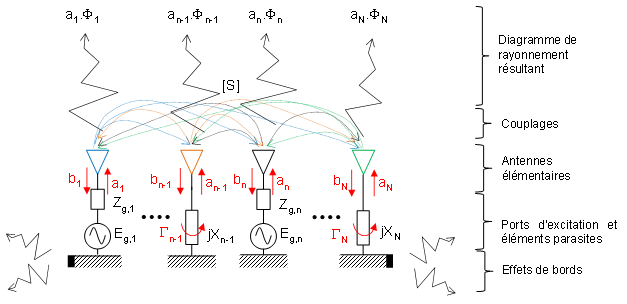
Principle diagram of an antenna with reconfigurable parasitic elements
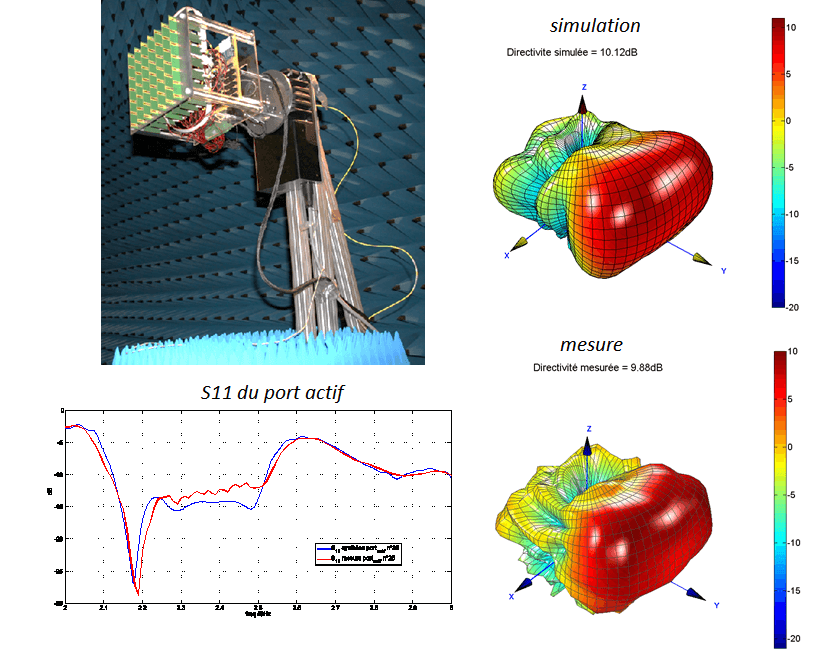
Antenna with reconfigurable parasitic element with example of sector pattern and matching – simulation / measurement comparison
A similar issue exists for multi-antenna addressing in radar imaging, for security applications for example. The challenge is to optimise the radiating aperture to guarantee maximum resolution while achieving real-time refresh. Current solutions struggle to reconcile sensitivity, resolution, processing time and compactness at the same time. These limitations are linked to the need to address a large number of antennas. To address this problem, a new principle of passive chaotic time-reversal distributor was developed, to drive a multi-antenna system with a single transmitted waveform. This pioneering work made it possible to launch a new research theme within the team on compressive multiplexers, which is positioned in the emerging field of compressive acquisition methods applied to microwaves. These multiplexers perform analogue coding of the signals received by an antenna system onto a single output. Digital decoding of the waveform allows as much flexibility as MIMO systems for microwave imaging, but with a reduced number of channels.
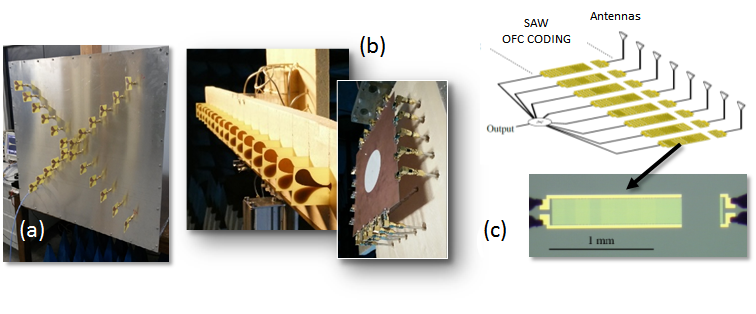
(a) Oversized cavity for single-shot MIMO imaging, (b) Planar chaotic multiplexers for microwave imaging, (c) Multi-antenna multiplexing using frequency-coded SAW filters
For imaging applications requiring high transmitted power, other routes are being explored, with the same desire to simplify the RF architecture and minimise acquisition time. In this case, the use of optoelectronics to design multi-source detection devices has made it possible to develop a radar system whose originality lies in its speed and scanning autonomy, obtained through a perfectly controlled radiation triggering mode, in its detection configuration and in the associated original imaging algorithm. The transmitter consists of a laser source, a power splitter and n ultra-wideband optoelectronic radiating sources whose repetition frequency varies from one source to another.
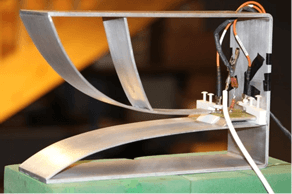
UWB antenna integrating a photoswitch for a scanning radar
Co-design methods for the synthesis of RF functions
Beyond the search for new architectures, optimising antenna efficiency also requires the systematic use of co-design methods to integrate system criteria. The purpose of a co-design approach is to define the best way to match functions together. The interface planes between functions thus become degrees of freedom that can be used to relax constraints during a global optimisation. At the antenna device level, co-design can be applied to the connection of filtering functions, LNAs or power amplifiers. But it can also be envisaged in an even more global way through the realisation of distributed functions associated with multi-element radiating antennas, in order to contribute to the shaping of radiation patterns. The requirements for antenna miniaturisation and for moving up in frequency can also be advantageously served by co-design, by shifting impedance matching difficulties onto the optimisation of the devices to be connected. This approach is of course made possible by pooling cross-disciplinary skills between antenna designers and passive and/or active circuit designers.
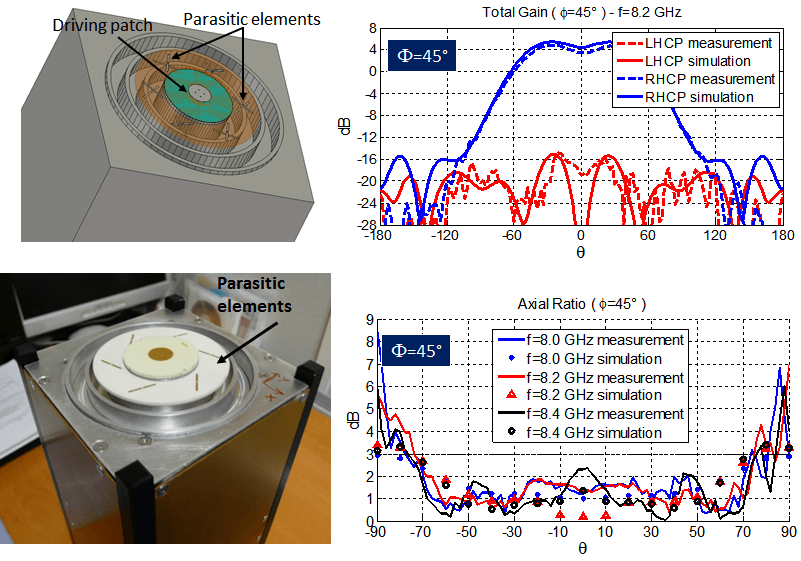
Ultra-compact X-band antenna for a CubeSat platform providing quasi-isoflux radiation in circular polarisation
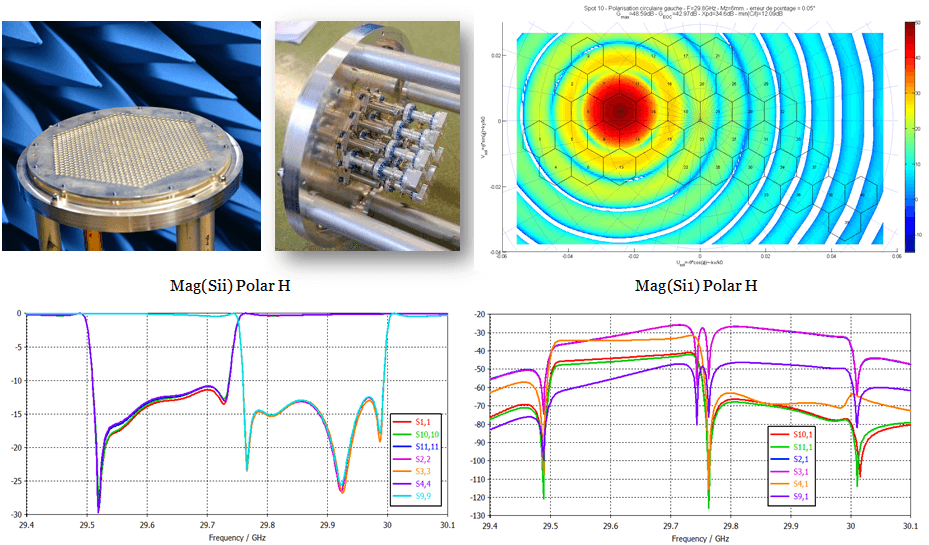
Joint design of an EBG focal array for multibeam space applications in Ka band (14-source demonstrator)
Co-design methods for the synthesis of RF functions
Another research area of the team aims to develop new materials, in collaboration with the MINT team, enabling the realisation and integration of innovative components offering optimised properties within antennas in frequency ranges from RF to millimetre waves (500 MHz to 64 GHz). These smart, functional materials exploit the agility of ferroelectric materials (whose permittivity varies with the applied field) and the ability of phase-change and phase-transition materials to switch from an insulating to a conducting state. The state of the art shows that the performance of current integrated devices is limited in terms of radiation efficiency, bandwidth, security and data rate. Moreover, they are particularly sensitive to their environment and context of use, which can alter their performance and vary their radiation or operating frequency. It is therefore essential to design agile antennas able to adapt to operating conditions, for example by being able to compensate for disturbances such as a shift in operating frequency or an altered radiation pattern.
The implementation of reconfigurable components (ferroelectric materials) and low-power switches (phase-change / phase-transition materials) makes it possible to drastically improve antenna operation at several levels:
The operating frequency of the antenna can be finely tuned using ferroelectric materials, thus compensating for the effect of the environment in which the antenna is used.
The radiation pattern can be modified by acting on the switches.
It is the choice of this interdisciplinary approach, from material to device, that makes this work original.
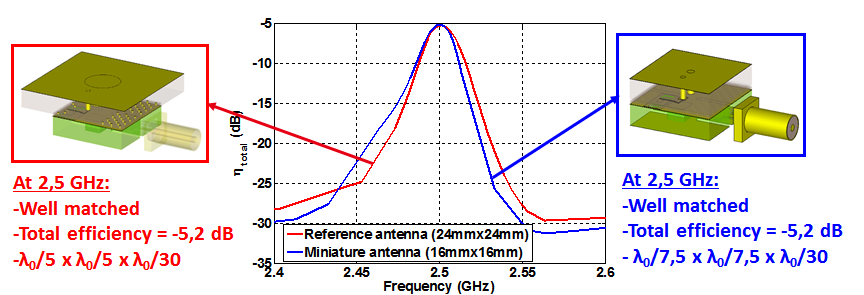
Miniaturisation of a 2.5 GHz antenna through filter-antenna co-design
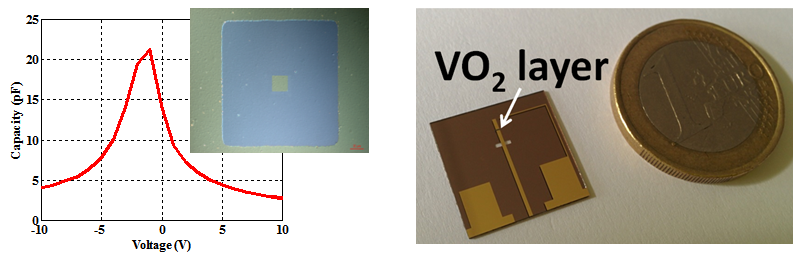
Realisation of tunable capacitors using ferroelectric materials (left) – Millimetre-wave antenna with frequency reconfigurability using a phase-transition material (VO2)