
ELITE
Printed Electronics for Telecoms and Energy
Head
Sylvain VEDRAINE
 sylvain.vedraine@xlim.fr
Secretariat
Marie-Laure GUILLAT
marie-laure.guillat@xlim.fr
Staff
7 permanent staff, 5 PhD students, 2 master’s interns
Overview
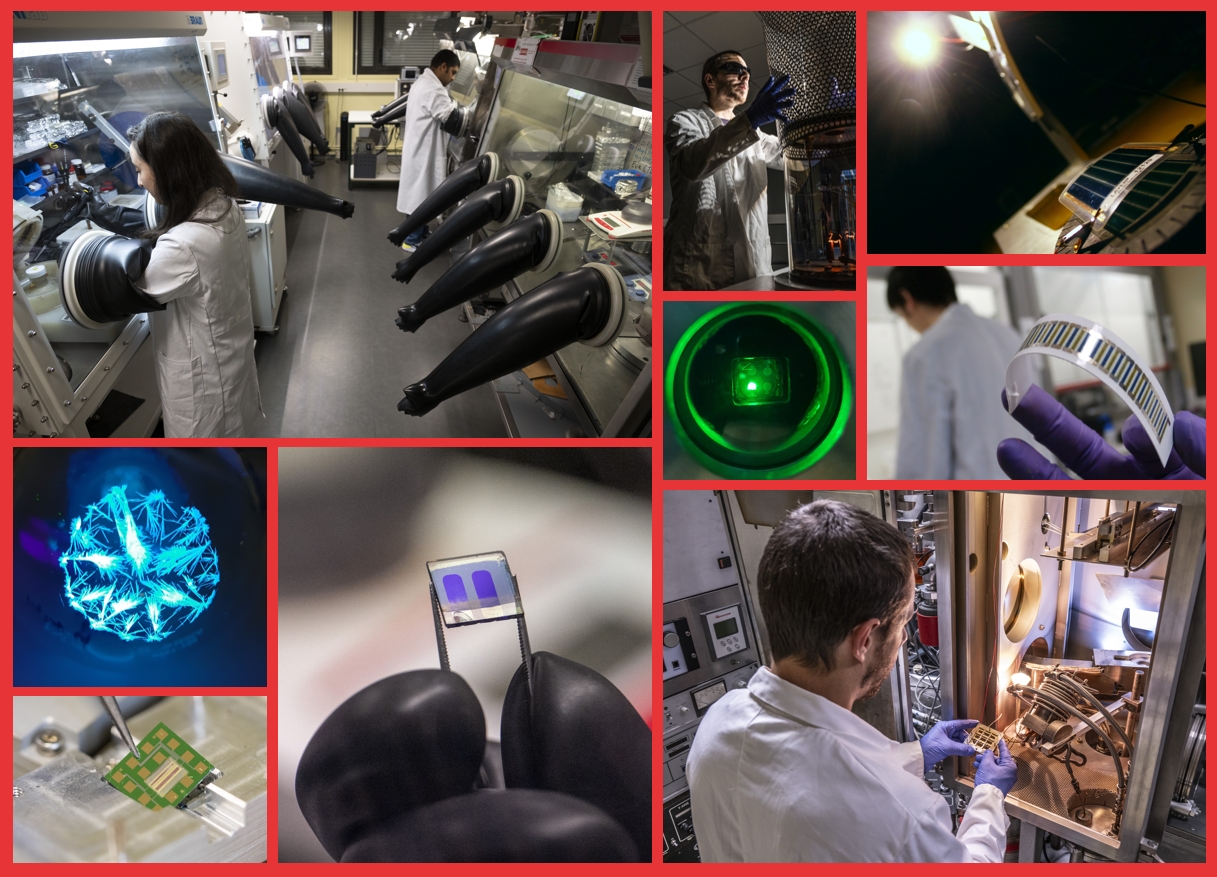
The Printed Electronics for Telecoms and Energy (ELITE) team specialises in the study and realisation of printable devices in Organic and Hybrid Electronics integrating innovative materials, notably for energy harvesting and conversion, new light sources, sensors, and also optical wireless communications.
The team’s particular know-how is based on the physics of organic and hybrid semiconductors, plasmonic nanostructures, nano-objects and composites, compatible with solution-processing methods, for the demonstration of components and varied architectures in which interfaces play a key role. The team’s activity relies on the PLATINOM technology platform, which integrates a complete set of fabrication technologies (solution-based or physical) and characterisations (optical, electrical, morphological and optoelectronic properties) of materials and components, as well as specific multi-physics (electrical, optical) modelling.
The ELITE team focuses on specific applications of printable electronics, in particular exploiting flexibility and semi-transparency, as well as dual functionalities adaptable to varied environmental conditions, with a focus on applications for the Internet of Things (IoT). This work aims to address several key technologies of the European strategy (Nanotechnologies, Advanced materials, Photonics and advanced manufacturing technologies), in connection with a set of regional, national and international academic and industrial partners. The projects led by the ELITE team respond to the main current energy and eco-environmental challenges with sober, low-carbon-footprint solutions.
The ELITE team is particularly interested in:
 The integration of innovative organic and inorganic materials into devices: halide perovskites, nanostructured carbon materials, nanocrystals, pi-conjugated semiconductors, etc.
The physics of thin films and interfaces
Indium-free transparent electrodes : tri-layer systems or systems based on metallic nanowires, plasmonic structures, etc.
Ink formulation and printing technologies (with a specific focus on inkjet technology)
Photovoltaic and thermoelectric energy harvesting
New-generation electroluminescent devices
Innovative applications of devices related to optical wireless communications
Main partnerships:
Academic partners : IRCER (Limoges), LABCiS (Limoges), IMS (Bordeaux), PPSM (Saclay), CEA, PCM2E (Tours), LUMIN (Saclay), INL (Lyon), IM2NP (Marseille), CINAM (Marseille), LAPLACE (Toulouse), IEMN (Lille), LPNE / University of Mons (Belgium), CINVESTAV (Mexico), University of Porto (Portugal), INESC TEC (Portugal), CRTEn (Tunisia), The Open University of Sri Lanka, A*STAR (Singapore), University of Tizi Ouzou (Algeria), Accademia Europea Di Bolzano (Italy), etc.
Clusters and CRTs: AVRUL, CISTEME, ALPHANOV, Alpha RLH cluster, Smart Power cluster, etc.
Industrial partners:DRACULA Technologies (Valence), IKAMBA Organics (Tours), KELENN Technology (Igny, Paris region), etc.
National and international research programmes:
LABEX ∑-LIM:Innovative ceramic materials for alpha-/beta-voltaic applications; heptazine molecular platform; micro-sources for autonomous sensors; perovskite oxides for optoelectronics.
ANR OPV4COM project (PRC 2024-2028):Organic photovoltaics for sustainable indoor IoT by simultaneous energy harvesting and optical wireless data reception. Coordination : J. Bouclé. Partnership : CISTEME, IM2NP, Dracula Technologies (Valence).
PEPR TASE SMART4MODULE project (targeted project 2023-2027): Design of optimal selective and semi-transparent OPV architectures and modules for AgriPV. Partnership : CINAM (Marseille), IM2NP (Marseille), LAPLACE (Toulouse).
Joint PhD supervision: CINVESTAV (Mexico, Mexico) in the field of halide perovskite photovoltaic components; University of Mons/LPNE (Belgium) in the field of organic photovoltaic (OPV) components for indoor applications.
Regional projects (research component) Nouvelle-Aquitaine 2025-2028: Organic Photovoltaics for Autonomous Communicating Objects (POOCA). Partnership: XLIM-ELITE, XLIM-SYCOMOR, CISTEME.