
From electromagnetism to continuum mechanics: morphogenetic metamaterials
Researchers from IRCER and XLIM have published in Nature Communications a method for designing mechanical metamaterials whose elasticity properties are locally controlled, without resorting to classical iterative optimisation. Thomas Fromenteze (XLIM), Philippe Michaud (IRCER), Vincent Pateloup (IRCER) and Ali Hassny (IUT du Limousin) co-authored this work, supported by the LabEx Sigma-Lim. It is a direct continuation of the work on morphogenetic metasurfaces carried out at XLIM and extends its principles to the field of continuum mechanics in collaboration with IRCER.
This work relies on the development of a generative model inspired by the self-structuring capacity of living things, allowing the emergence of structures satisfying locally prescribed mechanical properties.
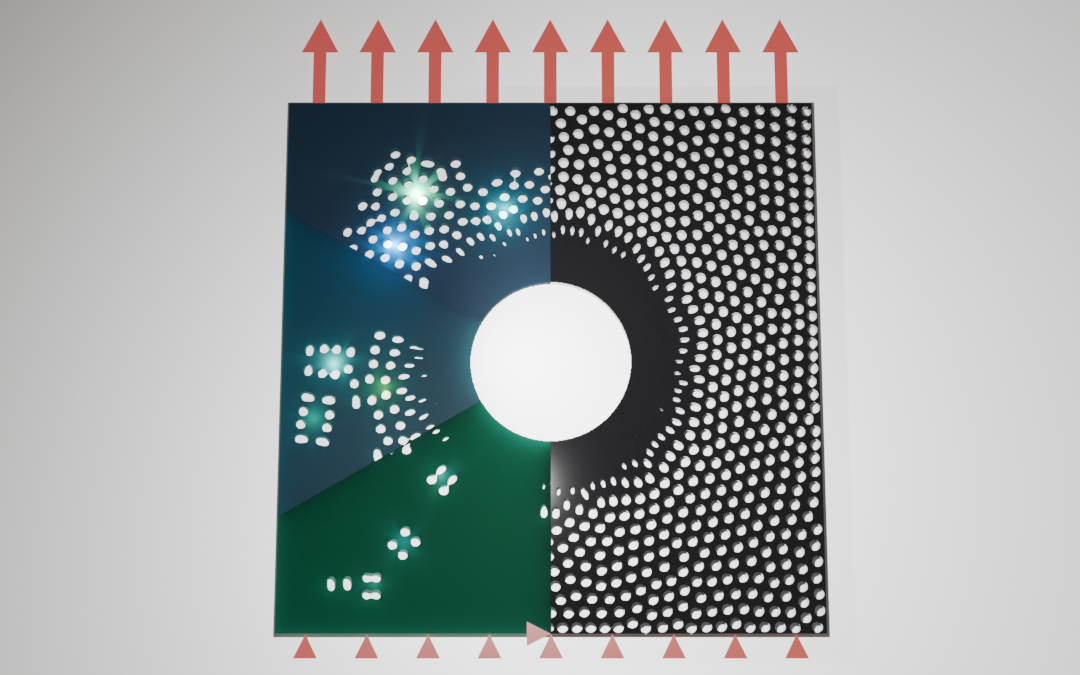
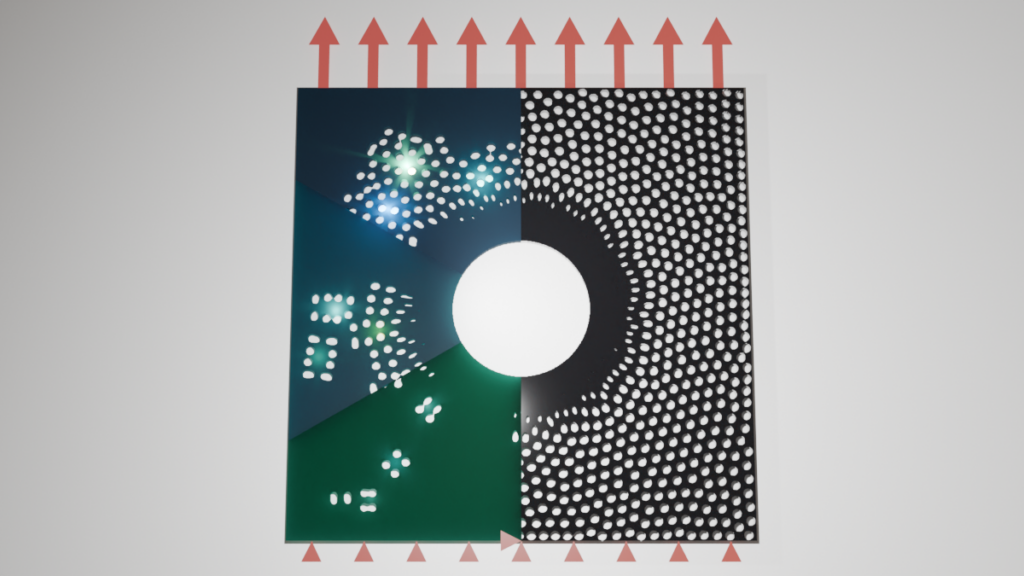
This first animation shows the growth of a mechanical invisibility cloak. Its development required new spatial transformation formulations suited to fourth-order mechanical tensors. These elasticity constraints were then satisfied by numerically growing a tailor-made porous architecture, cancelling displacements around the central cavity for a whole variety of mechanical loadings. Experimental validation confirmed the model’s predictions and established a new state of the art in simulation-experiment consistency for this type of problem.
This second animation shows an alternative way of applying the model, whose growth is this time guided by the stress fields of a structure under mechanical loading. A preliminary simulation of the homogeneous structure is enough to extract this field and to initiate the growth of a porous architecture, reducing the strain energy of the final structure. The simplicity of this coupling makes the method applicable to a wide variety of geometries and loading configurations.
These two approaches break with classical optimisation methods, which require iterative performance evaluation to guide each update of the geometry. Once the problem is defined, the generative model ensures autonomous growth : the structure self-organises to satisfy the mechanical objectives without a convergence loop. This approach is thus inspired by living things, where complex structures and functions emerge through self-organisation, without any global calculation orchestrating their development.
The IUT du Limousin also played a central role in this work. The experimental demonstration was carried out on its premises during Ali Hassny’s BUT2 GMP internship at XLIM, leading to the development of a new SAE (learning and assessment situation) in the GMP department. The IUT also fully covered the publication fees.
Références
T. Fromenteze, P. Michaud, A. Hassny, V. Pateloup. Morphogenetic mechanical metamaterials: Emerging tensor properties from self-organized structures. Nature Communications, 2026.
Code source : https://github.com/thomasfromenteze/Morphogenetic_Mechanical_Metamaterials_2D
T. Fromenteze, O. Yurduseven, C. Uche, E. Arnaud, D. R. Smith, C. Decroze. Morphogenetic metasurfaces: unlocking the potential of Turing patterns. Nature Communications, 14, 6249, 2023.