
GPPMM
Head
Fetah BENABID
 f.benabid@xlim.fr
Secretariat
Nadine AYMARD
nadine.aymard@xlim.fr
Staff
5 permanent staff
4 PhD students
2 postdocs
Overview
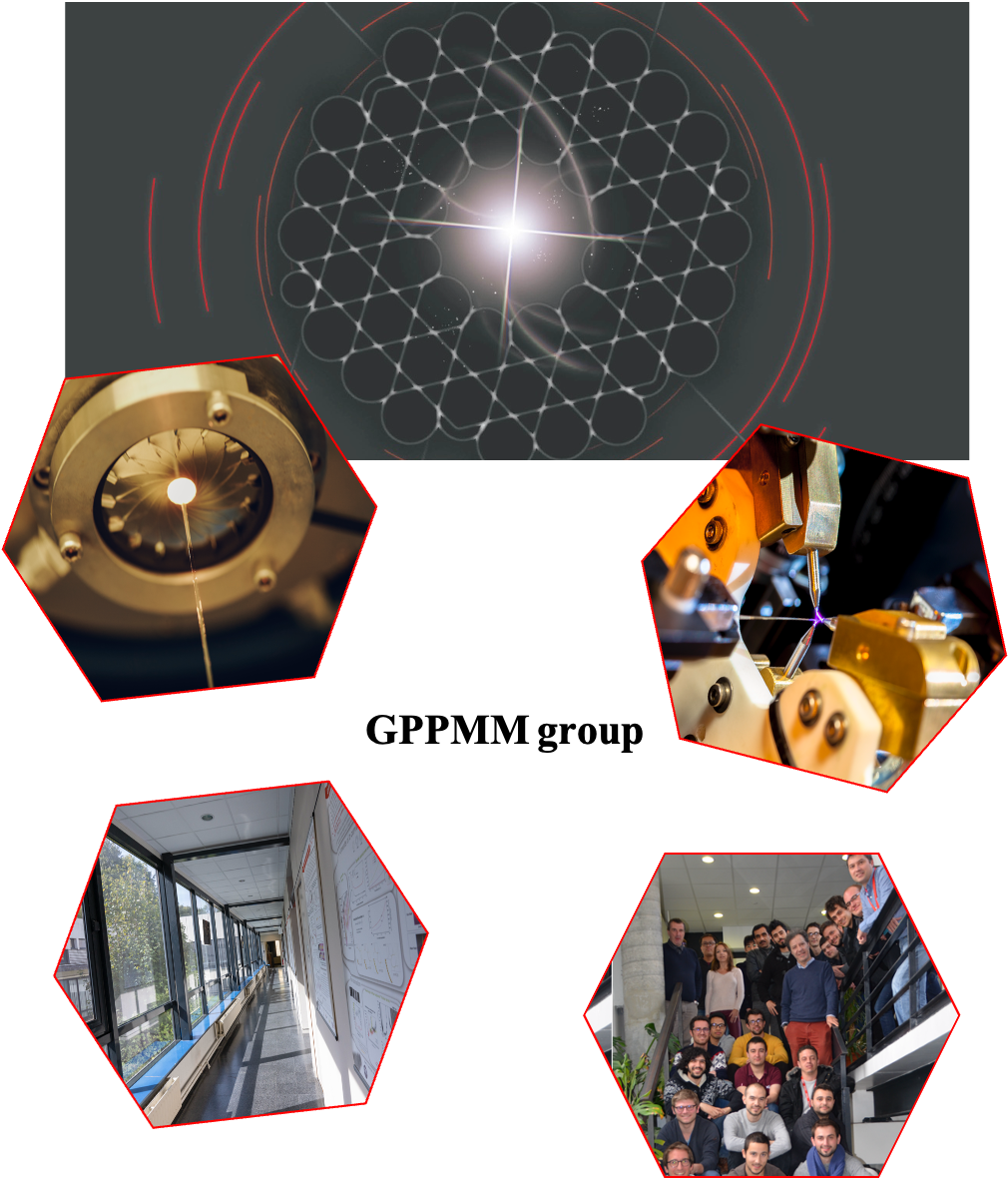
The Gas-Phase Photonic and Microwave Materials group (GPPMM) is a recent research axis at the Xlim laboratory. These activities stem from earlier work led by F. Benabid on hollow-core photonic crystal fibres (HC-PCF) and their ability to confine gas-phase materials inside HC-PCFs. The various scientific programmes of the GPPMM are based on the gases used: molecular gases, atomic vapours and ionised gases (i.e. plasma). The scientific programme comprises three main themes: (1) Physics and technology of HC-PCFs, (2) Coherent and nonlinear optics and (3) Atomic and quantum optics. The long-term goal of the GPPMM group is to anticipate the advent of the photonic computer by developing and bringing together the necessary ingredients and functionalities through its unique scientific and technical expertise in gas-phase materials and associated photonic components. In its efforts to achieve this goal, the GPPMM can draw on the expertise of the Xlim laboratory in micro/nano-electronics and photonics on the one hand, and of the IRCER laboratory for materials synthesis on the other.
Research topics
Axis #1: Physics and technology of HC-PCFs
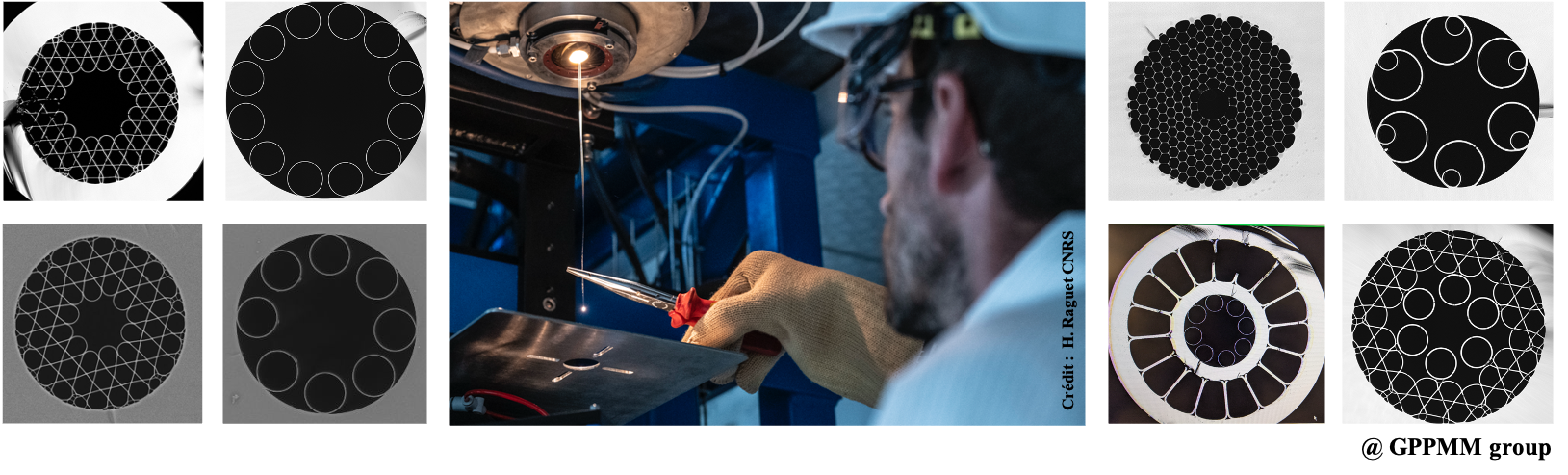
 Design and fabrication of HC-PCFs
Science of optical guidance mechanisms
Assembly of photonic micro-cells
Optical resonators and HC-PCF-based components
Axis #2: Coherent and nonlinear optics
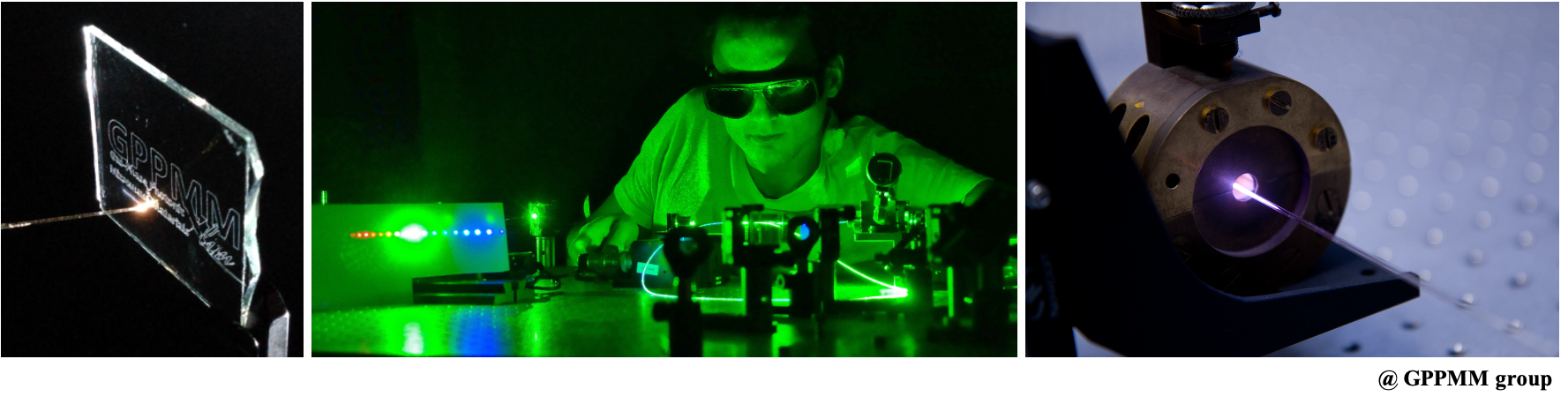
Generation of Raman frequency combs (CW and pulsed)
Photonic plasma
Generation of correlated and entangled photons
Axis #3: Atomic and quantum optics
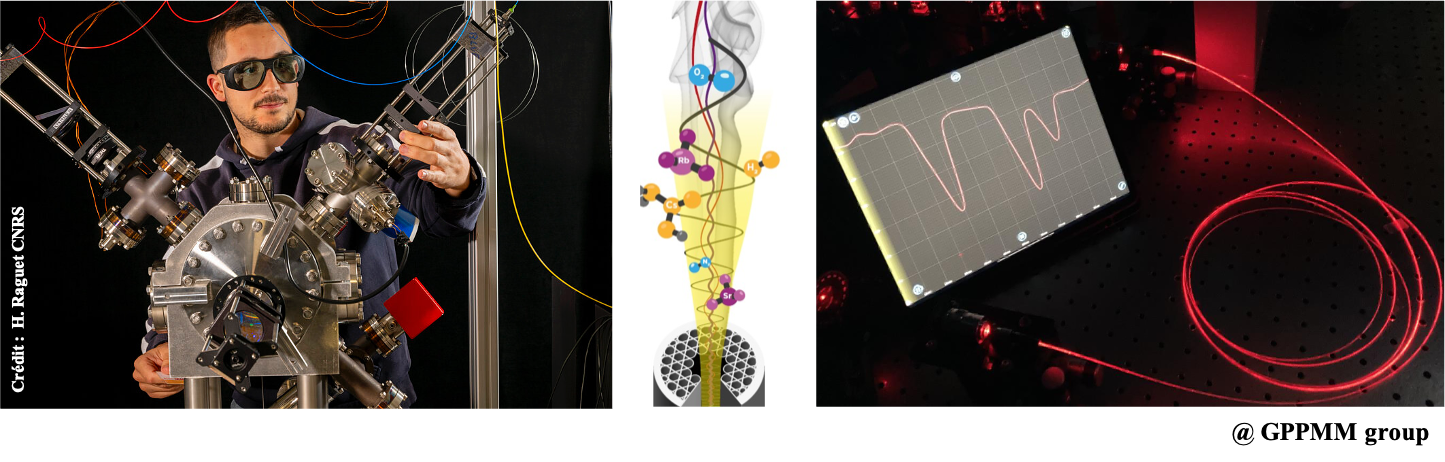
Molecular frequency standards and optical processing Photonic microwave atomic clock Laser cooling of thermal atoms confined in hollow-core fibres
Research programmes
National programmes
FOLIO | ANR PRCE | 2023-2027
Title: Fluids Of Light in hollow-core fiber mIcrO-cells
Partners: Laboratoire Kastler Brossel and GLOphotonics
Nationally structuring project | 2018–2022
Title: Setting up a French optical fibre sector for the lasers of the industry of the future (4F)
Collaborations with all the national laser manufacturers: Amplitude Systèmes, CILAS, Azur Light Systems, Université de Lille, École Polytechnique, FOTON, Eolite Systems, Keopsys, Quantel, Perfos, Thales
European programmes
Cryst3 | FET OPEN | 2021-2026
Title: Atom-light crystals in photonic crystals
Partners: University of Bologna, Institut d’Optique IOTA, University of Innsbruck, WIGNER, GLOphotonics, Alphanov, University of Modena
V-MAG | ANR QuantERA | 2024-2028
Title: Vector light enhanced atomic magnetometry
Partners: University of Glasgow, Wigner Research Centre for Physics, PTB Braunschweig, Johannes Gutenberg Universität Mainz, GLOphotonics, British Geological Survey, University of Limoges
Partnerships
Because of the technology we develop, we collaborate with many academic laboratories, both nationally and internationally, including IRCER, CELIA, ParisTech, LPGP in Orsay, the Institut de la Vision and Polytechnique in France; the University of Modena in Italy; DESY, the University of Stuttgart and the Max Born Institute in Germany; MIT, the University of Austin and Kansas in the USA; the Universities of Lavras and Campinas in Brazil, INRS in Canada and the Riken institution in Japan, not forgetting French research bodies such as the DGA.
We also collaborate closely with the socio-economic world and in particular with our spin-off GLOPhotonics, which develops and markets a new concept of photonic components called Photonic MicroCell™ (PMC) resulting from our research: https://glophotonics.fr.