
MACAO Advanced Design Methods through Analysis and Optimisation
Head
Nicolas DELHOTE
 nicolas.delhote@xlim.fr
Secretariat
Marie-Claude LEROUGE
marie-claude.lerouge@xlim.fr
Staff
5 permanent staff, 8 PhD students, 5 postdocs, 3 master’s interns
The MACAO team comprises 5 academics and researchers, 2 associate researchers and 1 research engineer, as well as about ten PhD students and postdocs. The MACAO team’s activities concern the study of the electrical properties of materials and of fabrication technologies, as well as the design and optimisation of passive devices of the RF front end. It is part of the RF Systems research axis.
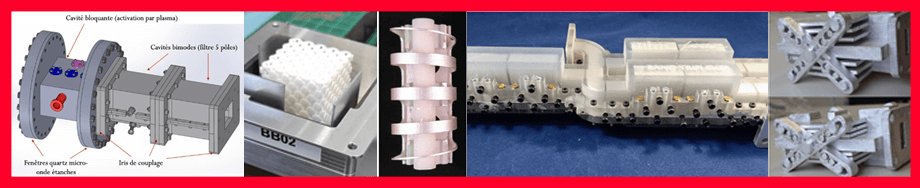
The research themes are divided into 4 projects:
Multiphysics modelling and characterisation
Here the MACAO team develops its own measurement, characterisation and modelling systems for electromagnetic phenomena related to microwave applications, in particular for the demanding needs of telecommunication satellites and electronic warfare.
This includes the modelling of phenomena related to breakdown in high-power devices, and the evolution of the properties of metallic deposits (electrical conductivity) and dielectrics (complex permittivity, temperature drift, …) as a function of frequency and temperature. The design of microwave devices carried out in the MACAO team makes it possible to design components that meet multiphysics constraints (losses, power handling, temperature resistance, …). These skills are applied in the H2020 Marie-Curie project TESLA (https://tesla-itn.hw.ac.uk/) involving 7 European countries, in which the MACAO team seeks to develop innovative high-power filters for future European telecommunication satellites.
The MACAO team’s expertise relies in particular on developing its own characterisation means and models that make it possible to extract the evolution of the properties of the materials used to build these components. The ANR project CANODEMS (https://canodems.xlim.fr/) aims to raise the temperatures involved in these characterisations to more than 1000°C in order to monitor the electromagnetic properties of ceramic materials in demanding applications. Various characterisation techniques for specific materials are being developed to support the fabrication technologies used, such as near-field microwave microscopy measurement and other approaches for measuring the complex permittivity (iso- or anisotropic) of 3D-structured materials used for various applications such as permittivity-gradient antennas (Xlim-Anywaves partnership) or UWB (Xlim-IRCER partnership):
The MACAO team has been working for several years on creating gas sensors sensitive to various substances (NOx, …) in collaboration with laboratories specialising in materials and fabrication technologies (INP Bordeaux, IEMN Lille). Through a recent collaboration with the UMI CINTRA (Singapore) and the ENSBP (Bordeaux) and IMS (Bordeaux) laboratories, a latest iteration of this gas sensor was designed. In particular, the impact of air humidity on the performance of a sensor using a layer of poly(3,4-ethylenedioxythiophene) polystyrene sulfonate – multi-walled carbon nanotubes (PEDOT:PSS-MWCNT) as the sensitive material was studied.
Methodologies and tools for the synthesis / optimisation of microwave functions
In this project the MACAO team develops its own tools for the synthesis and optimisation of microwave functions such as filters and multiplexers.
Co-design tools for filter/antenna functions are an example of the activities carried out in connection with the Antennas and Signals team, making it possible to optimise the size/efficiency trade-off of such an object. The MACAO team is currently involved in the ANR Astrid project CODIFIANT, dedicated to the Co-Design of a Compact and Frequency-Agile Filter-Antenna Device (codifiant.xlim.fr).
The MACAO team has developed expertise in the design of frequency-tunable filters and multiplexers, relying on tools and methodologies that make it possible to address frequency templates on multiple channels.
The specific synthesis of compact multiplexers and of filtering functions integrating frequency-dependent couplings and enabling the generation of transmission zeros on demand is part of the MACAO team’s know-how. The use of additive manufacturing technologies makes it possible to produce such devices in monobloc formats, avoiding assembly constraints and the inherent microwave losses.
The application of shape optimisation algorithms is an important lever which, when coupled with microwave measurements and/or simulations, makes it possible to optimise the geometry to be given to microwave components to reach a target template. These approaches, using genetic algorithms and others based on artificial intelligence, are currently applied to FPMS (Field Programmable Microwave Substrate) technology within the France-Canada ANR project RWC_FPMS (https://anr.fr/Project-ANR-18-CE24-0029).
Integration and packaging of microwave devices
The MACAO team develops original solutions based on specific technologies for the design of microwave components and circuits. The approaches developed aim to optimise the performance and integration of devices operating at ever higher frequencies.
The MACAO team has developed the LMST (Laser-Machined Substrate Technology) fabrication technology, based on laser micro-machining of substrates with high permittivity and very low loss tangent. This approach makes it possible to produce surface-mountable microwave functions suited to the 5G millimetre-wave bands (26 and 42 GHz). The potential of this approach comes from the collaboration with the IRCER laboratory (Ceramics Research Institute, www.ircer.fr ) within the Labex Sigma-Lim (www.unilim.fr/labex_sigmalim ), which supports the development of technical ceramic materials applied here to microwave components. Materials with very high performance (tan d = 2 10-5 @ 10 GHz, stability of properties with temperature (Tf 0 ppm/°C)) are thus used in terrestrial civilian applications or very demanding ones such as satellite telecommunications.
For more than 17 years the MACAO team has been using various additive manufacturing technologies (ceramic, polymer, metal) to produce original microwave functions. These approaches make it possible to limit the number of assembled parts, to bring several functions together within a single device and to achieve complex geometries that are difficult or even impossible to produce with other manufacturing technologies.
RF nanotechnologies
The MACAO team is involved in a consortium bringing together leading players around the use of carbon nanotubes to produce microwave functions (waveguides, Butler matrices, antennas, …) for high frequencies (E-band and beyond). Carbon nanotubes are identified here for their remarkable properties (very high thermal and electrical conductivity), which prove very promising for producing contacts (bumps) for component transfer or for the direct realisation on silicon of functions in the sub-millimetre bands. The ANR project TRICOT, whose coordination is led by researchers of the MACAO team, brings together the University of Grenoble, the III-V Lab and the UMI CINTRA (Singapore) around this theme. Application examples: (left) carbon-nanotube-based waveguide in E-band, (right) interconnection pad in W-band.
CNES, Toulouse, France – Thales Alenia Space, Toulouse, France – Thales Six GTS, Brive, France – Isorg, Limoges, France – CTTC, Limoges, France – CISTEME, Limoges, France – Inoveos, Brive, France – Alphanov, Pessac, France – III-V Lab, Palaiseau, France – CEA Tech, Grenoble, France – Université Grenoble Alpes, France – LAPLACE Laboratory, Toulouse, France – INP, Bordeaux, France – ENSCBP, Bordeaux, France – IEMN, Lille, France – INRIA, Nice, France – IETR, Rennes, France – UMI Cintra, Singapore – Carleton University, Ottawa, Canada – Ontario Tech, Oshawa, Canada – Heriot-Watt University, Edinburgh, United Kingdom – Universidad Publica de Navarra, Spain – Universitat Politecnica de Valencia, Spain – Christian-Albrechts-Universitaet Zu Kiel, Germany – Kungliga Tekniska Hoegskolan, Sweden – Technische Universitaet Graz, Austria – Universita degli studi di Perugia, Italy
 Axis joint laboratory (Xlim – Thales Alenia Space, Toulouse): members of the MACAO team are at the origin of this joint laboratory involving several research teams of the Xlim laboratory (MACAO, CCSNL, MINT)
ANR Canodems (Non-destructive Characterisation of Materials by RF Probe in harsh environments), 2018-2021): Xlim, IRCER, CISTEME
ANR TRICOT (Emerging Technology for the development of RF and millimetre-wave circuits based on carbon nanotubes), 2017-2021: Xlim, Université Grenoble Alpes, Cintra, III-V Lab
ANR PRCI (France – Canada) RWC_FPMS (Reconfigurable Wireless Components using Field programmable Microwave substrate), 2018-2023: IETR Rennes, Ontario Tech, Xlim, Carleton University, Orbcomm.
ITN H2020 Marie-Curie TESLA (Advanced Technologies for future European Satellite Applications) 2019-2022: Heriot-Watt University, Universidad Publica de Navarra, Universitat Politecnica de Valencia, Christian-Albrechts-Universitaet Zu Kiel, Kungliga Tekniska Hoegskolan, Technische Universitaet Graz, Universita degli studi di Perugia, Université de Limoges
ANR CODIFIANT (Co-Design of a Compact and Frequency-Agile Filter-Antenna Device), 2020-2022: CEA Tech, Xlim