
RUBI
Heads
Vahid MEGHDADI
Emmanuel MOULAY
 vahid.meghdadi@xlim.fr emmanuel.moulay@xlim.fr
Secretariat
Laëtitia BARC
Sophie HARDOUIN
Patricia LEROY
laetitia.barc@xlim.fr sophie.hardouin@xlim.fr patricia.leroy@xlim.fr
Staff
9 permanent staff
6 PhD students
Overview
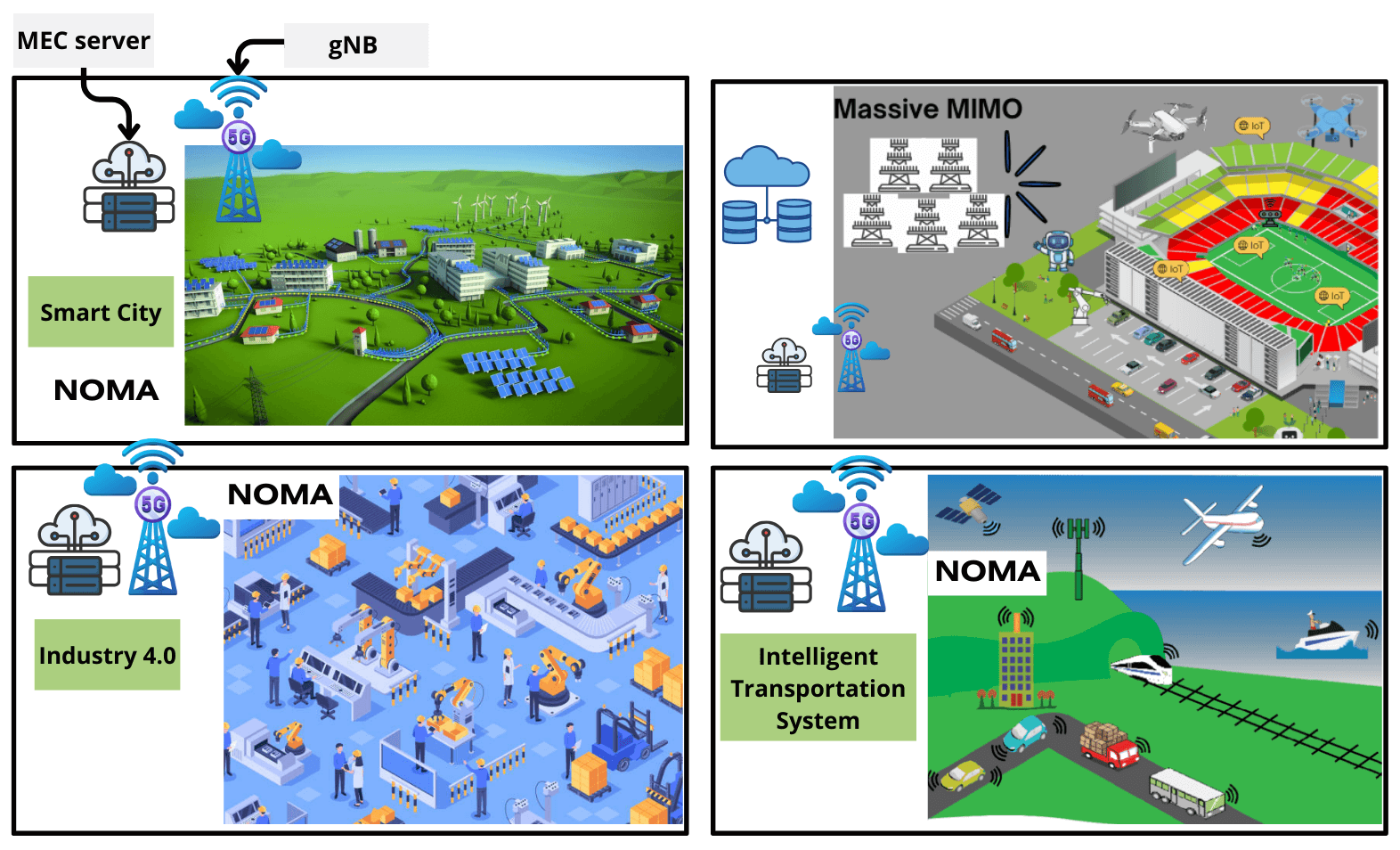
The main themes of the RUBI “Intelligent UBiquitous wireless networks” team concern the optimisation of resource allocation in large-scale networks such as the Internet of Things (IoT) and 5G (and beyond), as well as the transmission of massive data of different types and different qualities of service (QoS). Indeed, the coexistence of large-scale deployed sensor networks with legacy classic high-throughput cellular networks imposes new challenges in managing the overall QoS of the network in the context of smart cities, Industry 4.0 or intelligent transport systems (ITS). Node mobility problems, which arise at several levels in networks, are also the subject of particular developments. Moreover, the RUBI team is strongly involved in resource allocation issues that require the use of complex optimisation tools ranging from automatic control, signal processing and game theory to Artificial Intelligence (AI) techniques.
Research topics
Resource allocation in 5G networks and beyond and QoS management in the IoT
 The RUBI team works on resource allocation strategies in wireless telecommunication networks. The objective is to allocate resources intelligently, in frequency and power for example, to the different nodes of the 5G network and beyond while guaranteeing QoS to the different users. The RUBI team thus proposes to exploit the spatial, frequency and time diversities of the radio channel to implement link adaptation strategies (UEP and UPA techniques for example) and scheduling that allow the most optimal and dynamic interaction possible between the PHY, MAC and Application layers for the delivery of images or videos. In this respect, combinations of the MIMO concept with orthogonal (OFDMA) or non-orthogonal (NOMA) access techniques such as Power Division Multiple Access (PDMA) or Sparse Code Multiple Access (SCMA) are relevant solutions in this cross-layer optimisation strategy meeting multi-user QoS. Similarly, still with the aim of improving spectrum management and energy efficiency in the context of the massive deployment of IoT networks comprising tens or even hundreds of thousands of sensors, the second step consists in implementing new centralised/decentralised approaches to virtual network slicing (Network Slicing), separation of the control plane from the data plane with Software Defined Networking (SDN), and decentralised deployment of Multi-access Edge Computing (MEC) using multi-agent systems to guarantee heterogeneous QoS requirements for multiple users.
AI and Compressive Sensing techniques applied to heterogeneous networks
The RUBI team also works on more demanding heterogeneous wireless telecommunication networks with strong interference and significant QoS constraints, for example in industrial environments (Industry 4.0) or for ITS, based on deep learning techniques such as Deep Learning and Deep Reinforcement Learning (DRL). In this context, it is interested in virtual functions (VNF) and mobility management in 5G and beyond cellular and vehicular networks. For multimedia wireless sensor networks, the RUBI team seeks to propose innovative network deployment solutions making it possible to deliver, on the uplink, image or video in a reliable and low-complexity manner. To do so, link adaptation strategies integrate Compressive Sensing schemes with low-complexity learning techniques that reduce the acquisition rate of multimedia sensors, for example for video surveillance or transport. Indeed, since the sensed data are very often correlated, it is possible to take advantage of this to reduce the number of transmissions. In addition to Compressive Sensing techniques, Matrix Completion techniques are used to obtain missing data. Various techniques such as clustering or principal component analysis (PCA) are used.
Massive MIMO and improved spectral efficiency
The RUBI team also studies the use of a very large number of antennas (Massive MIMO) at reception, at transmission and in reflecting relays, to increase the capacity of transmission channels, which is particularly useful in densely populated areas, for example for smart cities. Hybrid beamforming techniques have been developed to reduce radio complexity. One of the active research directions concerns reconfigurable intelligent surfaces (RIS) to improve the coverage of cellular networks. High mobility is another challenge addressed, which generates channels that are doubly selective in time and frequency. The RUBI team works on OTFS modulation and the problems related to its channel identification. It uses machine learning techniques to reduce implementation complexity.
Research programmes
European programmes
2020-2025 ERA-NET CHIST-ERA Project SAMBAS.
2017-2020 H2020-ICT-2016-2017 Project SmartMet.
National programmes
2023-2028 PEPR Networks of the Future FITNESS.
2023-2028 PEPR Networks of the Future PERSEUS.
2022-2026 ANR-21-CE25-0005 SAFE.
2020-2024 ANR-20-CE25-0004 MOMENT.
Partnerships
Airbus – Amirkabir University of Technology, Iran – Audensiel – Caplogy – CEA – CISTEME – IMT Atlantique – LaBRI, University of Bordeaux – LAMIH, Université Polytechnique Hauts-de-France – LEAT, Université Côte d’Azur – LIMOS, Université Clermont Auvergne – LS2N, École Centrale de Nantes – L3i, University of La Rochelle – Orange Lab – Polytechnique Montréal, Canada – Sup’Com, Tunisia – Transpod – Université Gustave Eiffel – University of Nebraska–Lincoln, USA.