SIR
Head
Benoît CRESPIN
 benoit.crespin@xlim.fr
Secretariat
Julie BREDOUX
julie.bredoux@xlim.fr
Staff
9 permanent staff, 3 PhD students, 2 master’s interns
Overview
Based in Limoges, the expertise of the SIR (Simulation, Image, Rendering) team lies in simulation and realistic rendering techniques in image synthesis. The research work covers a spectrum ranging from modelling to realistic rendering and interactive visualisation of complex scenes, including GPU acceleration of particle-based simulation techniques and the geometric and/or topological reconstruction of data obtained by imaging.
Research topics
Visualisation of complex molecular structures
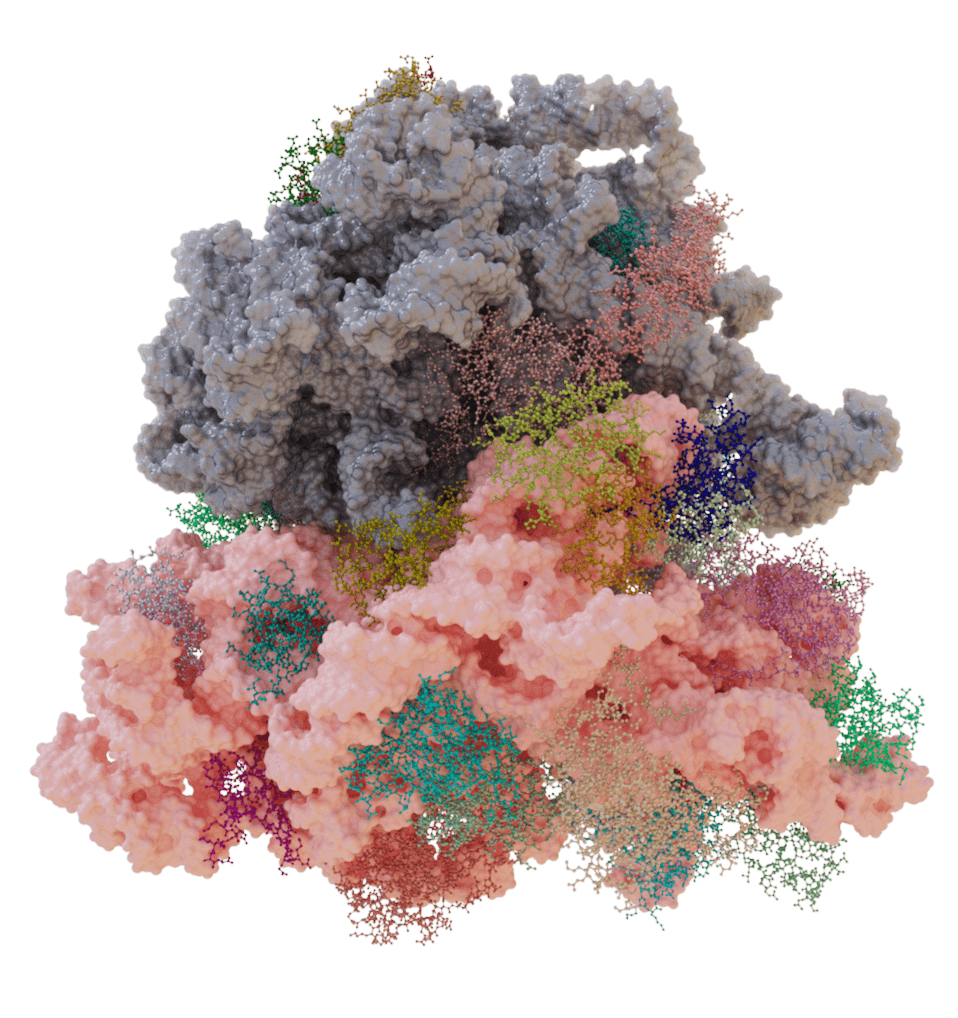
 Studying the structure of molecular complexes is crucial for understanding their functioning and interactions. The Solvent Excluded Surface (SES) is a powerful tool for analysing their properties, but building it for large structures is a challenge. The SIR team is developing innovative GPU-based methods for computing the SES of large proteins, thus opening new perspectives for studying the structure and function of these molecular complexes.
GPU numerical simulations
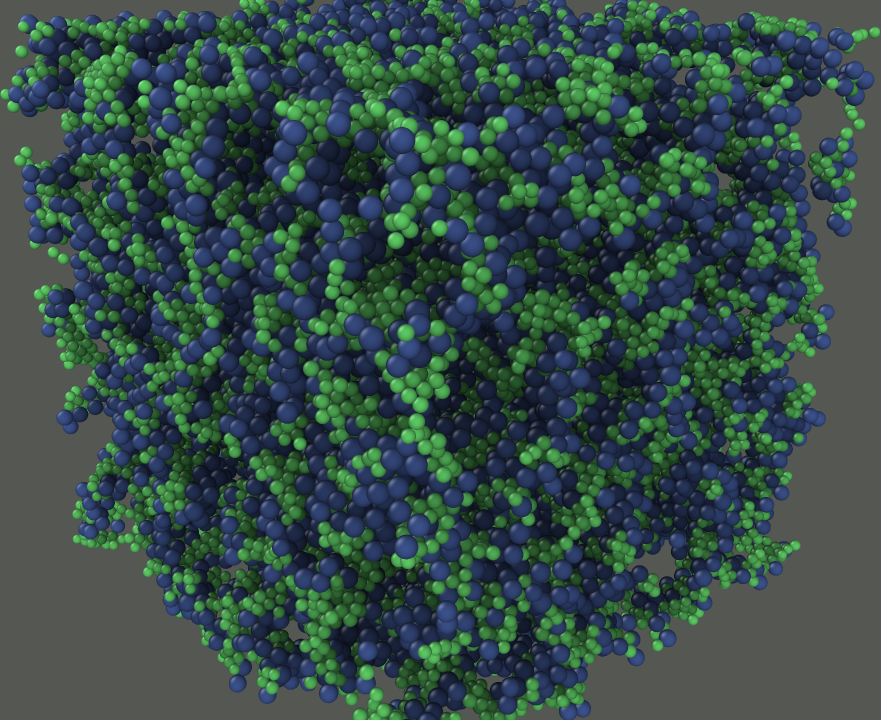
Neighbourhood search in particle-based simulations, in particular colloidal suspensions, is an important challenge. The SIR team is developing algorithms to improve this search using Delaunay triangulation, in particular on GPU. The results obtained within the ANR project SOMA-DNS (ANR-20-CE46-0004) in connection with the IRCER laboratory open new perspectives for particle-based simulations.
Modelling and realistic rendering of natural phenomena
Real surfaces very often have a complex appearance, resulting in the real world from a set of physical, chemical and biological phenomena that are largely influenced by the environment to which objects are subjected. Direct modelling / simulation of these appearance-change phenomena, as well as taking their mutual influences into account, are particularly difficult (especially in a real-time setting).
For several years, real-time rendering of rain and its interaction with the environment has been tackled, as has the rendering of the visual effects inherent to the complex interactions between trees and rain, in order to increase the realism of natural rainy scenes. It is a complex phenomenon involving a large number of processes influenced by various interdependent factors (wind, lighting, etc.).