
XLIM Research | Photonics: Advance in optical noise control thanks to deep learning
Researchers from the XLIM Institute have demonstrated, thanks to artificial intelligence, that it is now possible to predict and control complex nonlinear optical phenomena that were until now considered unpredictable. This work, conducted notably within the ERC STREAMLINE project and a Franco-German collaboration, was published in Nature Communications, and selected for the special issue Optics & Photonics News – Optics in 2025 of Optica, which highlights the year’s major advances in optics and photonics.
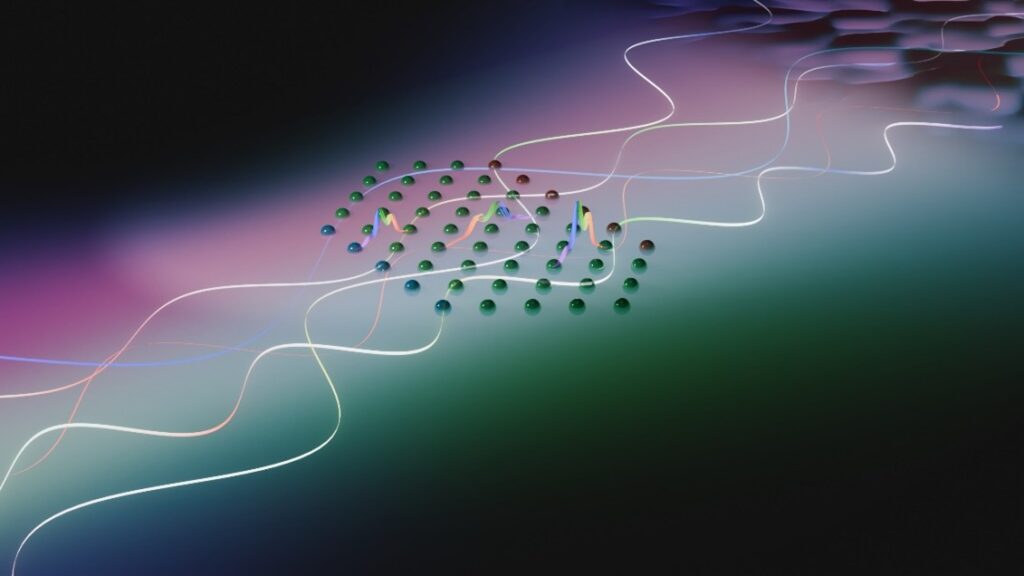
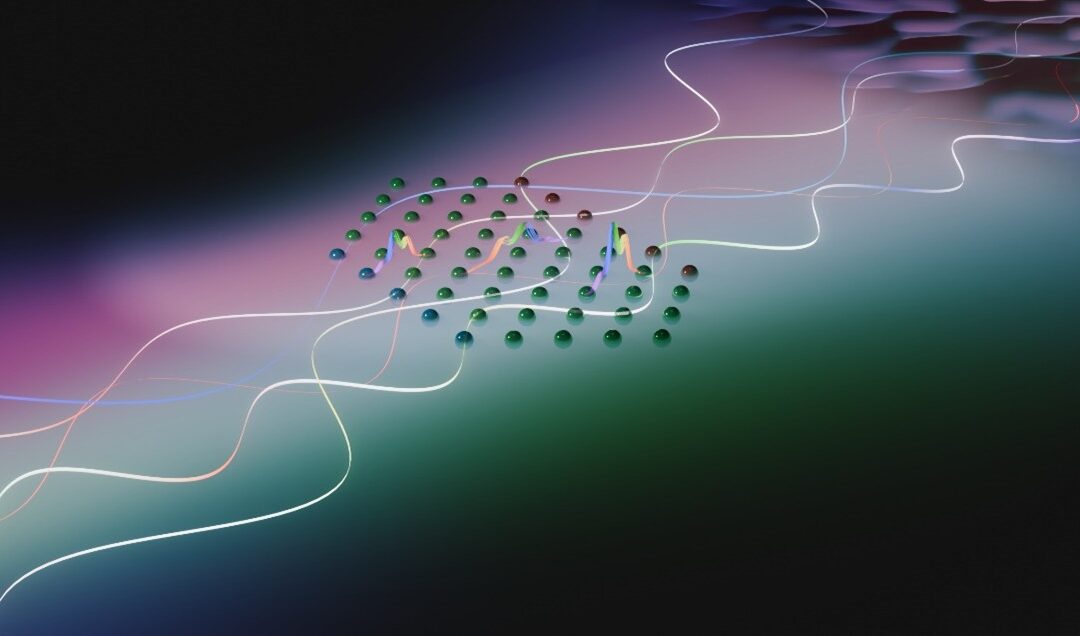
Illustration of the concept of artificial neural networks for controlling nonlinear instabilities in fibre optics. Copyright: Benjamin Wetzel
This research shows how deep learning can decode and even steer the spectral instabilities resulting from modulation instability, a notoriously chaotic process in nonlinear optics, known since the 1970s to limit the performance of photonic systems. This phenomenon corresponds to an amplification of small perturbations (typically noise) through the interaction between the nonlinearity of the material and the natural dispersion of light. When an optical pulse propagates in a fibre, the intensity of the perturbations grows and the noise strengthens, thus causing a chaotic cascade.
By combining neural networks and deep learning on experimental data, the team led by Benjamin Wetzel succeeded in extracting hidden information from noisy and fluctuating optical signals at a rate of 50 million pulses per second. Yassin Boussafa, lead author of the study, thus showed that by injecting weak coherent optical pulses (barely distinguishable from noise), it is possible to restructure and master these chaotic dynamics. This level of control, demonstrated experimentally thanks to advanced real-time spectral measurement techniques, opens the way to applications in optical signal processing, imaging and secure communications.
The study was carried out in partnership with the FEMTO-ST Institute (CNRS/Université Marie et Louis Pasteur) and the Leibniz University Hannover (Germany), and benefited from the support of the European Research Council (ERC – STREAMLINE project), the French National Research Agency (ANR – OPTIMAL project) and the Nouvelle-Aquitaine Region (SPINAL project).
References:
Y.Boussafa, L. Sader, V. T. Hoang, B. P. Chaves, A. Bougaud, M. Fabert, A. Tonello, J. M. Dudley, M. Kues, and B. Wetzel, “Deep learning prediction of noise-driven nonlinear instabilities in fibre optics,” Nature Communications 16, 7800 (2025) https://doi.org/10.1038/s41467-025-62713-x
Y.Boussafa, L. Sader, V. T. Hoang, B. P. Chaves, A. Bougaud, M. Fabert, A. Tonello, J. M. Dudley, M. Kues, and B. Wetzel, “Neural Networks Decode Noise-Driven Nonlinear Fiber Dynamics,” Optics & Photonics News, 12(36), 41 (2025) – Link
Contact:
Dr. Benjamin Wetzel (benjamin.wetzel@xlim.fr)
CNRS Research Scientist, XLIM Institute